



CFM welcomes Paula Malo de Molina and Alberto Álvarez-Fernández as Ramón y Cajal researchers in 2026
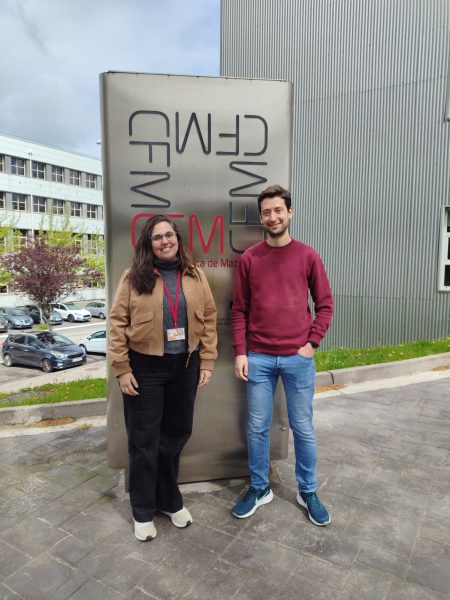 The Materials Physics Center (CFM, CSIC–UPV/EHU) has welcomed in 2026 two new Ramón y Cajal researchers: Paula Malo de Molina and Alberto Álvarez-Fernández, further strengthening its capabilities in strategic areas of materials science.
Both researchers achieved outstanding results in the last call. Alberto Álvarez-Fernández ranked first in his research area (“Industrial production, civil engineering and engineering for society”), among nearly 40 candidates, and has also been awarded an additional CSIC excellence grant (RyC-MaX 2024) of €300,000 to support his research. Paula Malo de Molina ranked fifth in the area of Chemical Sciences and Technologies, among around 60 positions, and has obtained an additional €100,000 CSIC grant under the talent attraction programme associated with the Ramón y Cajal scheme.
Paula Malo de Molina: soft matter and macromolecular organization
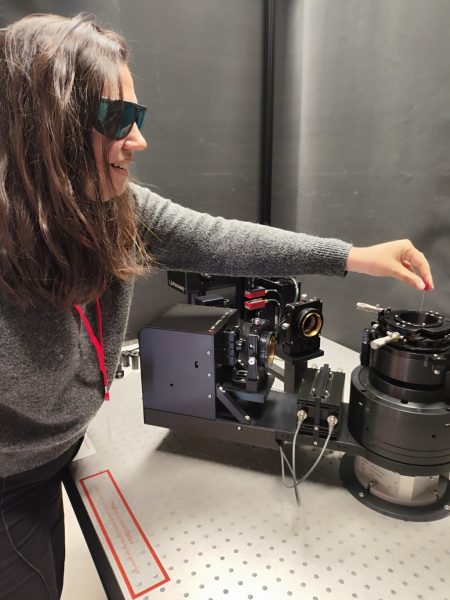
Paula Malo de Molina working at the lab
Paula Malo de Molina’s research focuses on understanding how polymers and biomolecules organize and move in complex environments. Her work addresses systems such as single-chain polymer nanoparticles, nanogels, and complex coacervates—materials that are key to the study of biological condensates and the development of emerging biomimetic technologies.
A central aspect of her research is the use of advanced scattering techniques—light, X-ray, and neutron scattering—combined with complementary methods to probe structure and dynamics across multiple length and time scales. By integrating polymer synthesis, physical characterization, and modeling, her work aims to uncover the principles governing macromolecular organization, contributing to the design of new functional materials and bridging polymer physics with biological soft matter.
She obtained her PhD in Physical Chemistry from the Technical University of Berlin, where she investigated complex polymer networks. She then carried out postdoctoral research at the University of California, Santa Barbara (USA), in the Department of Chemical Engineering, where she further developed her work on macromolecular self-assembly and advanced characterization techniques. She later joined CFM and held an Ikerbasque Research Fellow position. Through the Ramón y Cajal programme, she aims to strengthen experimental capabilities in soft-matter characterization and foster interdisciplinary research at the interface of polymer physics and biological materials.
Alberto Álvarez-Fernández: functional nanostructures for sensing and optoelectronics
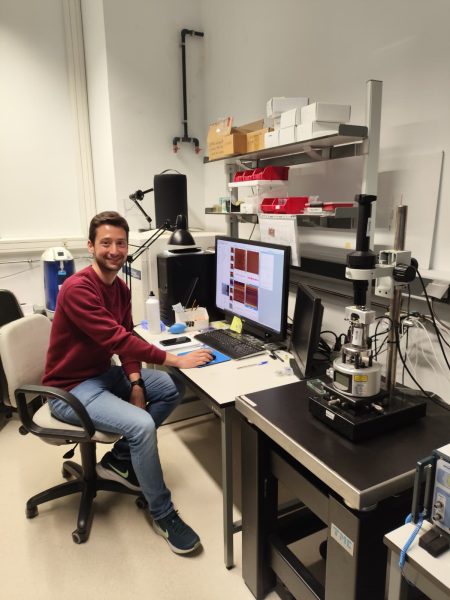
Alberto Alvárez working at the lab
Alberto Álvarez-Fernández’s research focuses on the development of tunable nanostructures and nanomaterials for biosensing and optoelectronic applications. His work explores how molecular self-assembly and nanostructuring techniques can be used to design materials with specific optical and sensing properties.
His approach combines materials science, polymer chemistry, and physics, together with advanced characterization techniques such as Raman spectroscopy, X-ray scattering, ellipsometry, and microscopy. His contributions include pioneering experimental demonstrations of optical metasurfaces fabricated via molecular self-assembly and new strategies to expand the applications of mesoporous nanostructures. In addition, he investigates the enhancement of biosensing technologies through the nanostructuring of Quartz Crystal Microbalance sensor surfaces.
Álvarez-Fernández completed his PhD at the University of Bordeaux in 2018, working on block copolymer-templated plasmonic metasurfaces. He then joined University College London (UCL) as a postdoctoral researcher, where he later became a Senior Research Fellow. In 2022, he was awarded an ADMIRE MSCA Fellowship to carry out research at Trinity College Dublin. His work has been recognized with several prestigious awards, including the European Materials Research Society Young Researcher Award (2021) and the Royal Society of Chemistry Materials Chemistry Horizon Prize (2023). In 2023, he was also awarded a Gipuzkoa Fellowship to join CFM, where he now continues his career as a Ramón y Cajal researcher.