


Pablo Beato, new Ikerbasque Professor at CFM
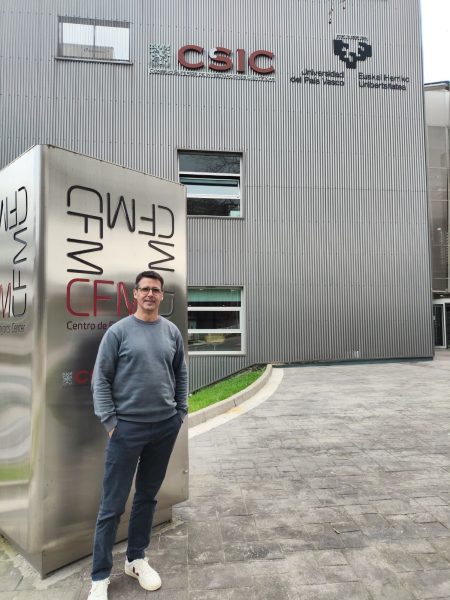 Pablo Beato, an expert in heterogeneous catalysis, is the newest addition to CFM through the Ikerbasque program. After a long career in this research area, and with 20 years of experience in the company TOPSOE, he joins CFM to lead a new research line focused on the design of heterogeneous catalysts aimed at shortening the distance between basic research and the industrial production of systems with real-world applications.
Professor Beato was born in Burgos, but soon moved with his family to Germany, where he grew up and received his education. He graduated in Chemistry from the University of Marburg and later obtained a MSc degree from the same University. He began his research career at the prestigious Fritz Haber Institute of the Max Planck Society in Berlin, a historic center for physical chemistry and catalysis research. There he obtained his PhD in 2005, already specializing in heterogeneous catalysis and operando spectroscopy.
Although he carried out extensive work on catalyst synthesis, his interests quickly shifted toward understanding how catalytic processes occur: how catalytic materials form, and how they behave under real operating conditions, such as high temperatures and pressures, typically applied in industrial catalysis. His PhD work focused particularly on selective oxidation reactions involving molybdenum, vanadium, or tungsten oxides. During this period, he also built his first operando reactor.
“I have spent a lot of time thinking about how to build small-scale reactors capable of monitoring real industrial processes.”
During his postdoctoral period, he further specialized in vibrational spectroscopy techniques, providing analytical support to many researchers who required this technique for their studies.
He then moved to industry to apply his academic knowledge to real-world challenges and gain new skills in technology transfer. He applied for a scientist position at the Danish chemical engineering company TOPSOE. The position required an expert in zeolites, a class of microporous minerals commonly used as catalysts and adsorbents. This opportunity marked the beginning of what turned into one of his main research interests: exploring the chemistry and physics of microporous materials, which became a defining focus throughout his career.
TOPSOE is among the leading companies in catalysis worldwide, despite its relatively modest size of around 2,000 employees. The company develops catalysts and fundamental industrial processes such as those used in the production of methanol, ammonia, hydrogen and synthetic fuels, among many others. It has also been a pioneer in maintaining a strong commitment to research and development within the company itself. This structure allowed basic research lines to coexist with industrial production, ensuring an almost immediate transfer of scientific knowledge to real industrial applications.
“TOPSOE is a unique place; for me, the equivalent in the field of catalysis to what IBM or Bell Labs represented for electronics in their heyday. It has always had the ambition to improve catalysts starting from the most fundamental understanding of the processes involved.”
During his time in industry, Professor Beato co-supervised 35 PhD theses and established collaborations with research centers, synchrotron facilities, and academic groups specializing in catalysis.
Over his 20-year career at TOPSOE, he eventually became one of the company’s lead scientists, taking responsibility for the spectroscopy laboratories and several catalyst development programs. He is widely recognized as an expert in operando spectroscopy, zeolites and his contributions to the understanding of the methanol to hydrocarbons reaction, one of the future key catalytic reactions to produce sustainable chemicals and fuels.
For some time, he had been contemplating a return to academia in order to investigate questions about catalyst efficiency and reaction mechanisms that remained unresolved during his industry career. While exploring relevant research institutions, he became aware of the work being carried out at CFM (Centro de Física de Materiales) in related areas and contacted its director, Celia Rogero, to present his profile. At the same time, his family was interested in exploring life in the Basque Country due to a professional opportunity for his partner, also a researcher currently working at CEIT. The Ikerbasque call for established talent provided an ideal opportunity to incorporate such a broad and specialized profile into the CFM.
Celia Rogero explains:
“At CFM we want to maintain the essence of fundamental research without giving up an innovative, ambitious and risk-taking vision, while also moving closer to the real needs of industry. Materials are not only the destination; they are the pathway to understanding the processes that govern their behavior. In this sense, Pablo’s background seemed exceptional to us, and we are delighted to welcome him to our team.”
Professor Beato adds:
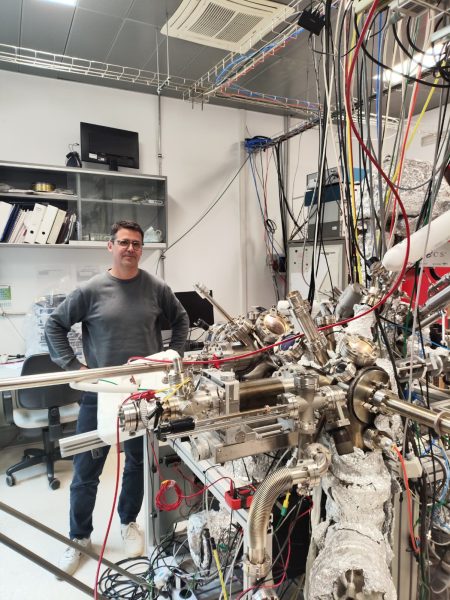 “I have been fortunate to work on advanced catalytic systems that produce significant quantities of high-value chemicals and fuels, whilst maintaining a strong connection with academia, and investigating fundamental questions in catalysis. I am very excited to contribute to CFM with my experience, helping to innovate and build bridges between academia and industry.”
Professor Beato will carry out his research in the facilities that CFM occupies in the new IKERBASQUE building. His work will focus on the synthesis of new catalysts, operando spectroscopic analysis, and catalytic testing.
The materials developed in his lab are intended to bridge the gap between the nano- and kilogram scales, merging CFM’s deep expertise in surface physics with industrial-grade wet chemical synthesis.
“For me, working at CFM offers a unique opportunity to pursue an interdisciplinary approach to materials synthesis, characterization, and testing, a path I find exciting because of its immense potential for innovation.”
In addition, Professor Beato has already shown a remarkable dynamism in engaging with the local scientific community and building new collaborations across institutions. An example of this is the collaboration he has recently initiated with DIPC Ikerbasque Professor Juan Manuel García Ruiz within one of the research lines of the PROTOS project (ERC Synergy Grant), which investigates the role of silicate surfaces in self-assembly processes related to understanding the origins of life.
Professor Beato concludes:
“I love Donostia and I am very grateful to have found such a stimulating environment. It allows me to broaden the scope of my research, seek inspiration in new areas, and develop my potential at the highest level.”