



PhD Thesis Defense | Jozef Janovec
 From optical properties to passive radiative cooling applications of cement-based materials
 From optical properties to passive radiative cooling applications of cement-based materials
June 24, 11:00
CFM Auditorium
Candidate: Jozef Janovec
Supervisors: Jorge Sánchez Dolado, and Andrés Ayuela
SUMMARY
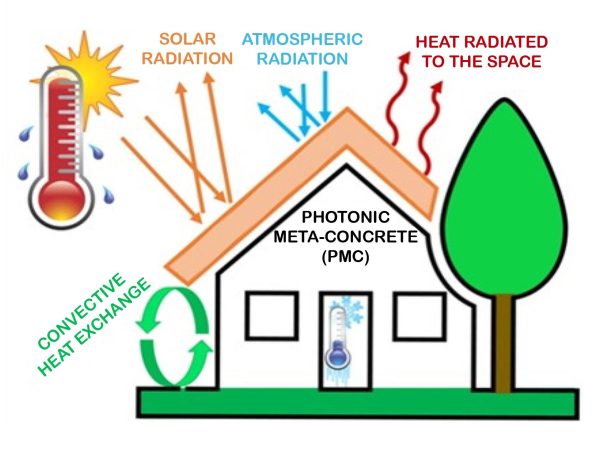 Cement and concrete are of immense importance to society as concrete is the most widely produced and, after water, the second most used material on Earth. Traditionally, research in the field of construction materials has focused primarily on the mechanical properties of concrete. However, significant carbon footprint of buildings has attracted new scientific interests that aim to reduce CO$_2$ emissions. As one of the potential solutions, photonic concrete (PC) has been proposed as an innovative construction material. By incorporating photonic and radiative cooling functionalities into cement-based materials, PC represents a promising candidate for the next-generation thermal envelopes and insulation for effective thermal regulation of modern buildings and cities. In particular, PC has attracted growing interest for daytime radiative cooling applications. These technologies offer an improved energy-efficiency with the potential to substantially reduce the demand for air-conditioning, which is an important contributor to global energy consumption. Beyond energy savings at the building scale, large-scale use of radiative cooling materials could play an important role in mitigating the urban heat island effect, a phenomenon caused by excessive heat absorption and limited night-time cooling in densely built areas.
Radiative cooling is based on a passive dissipation of heat into outer space by emitting thermal radiation through the atmospheric transparency window (ATW) in the infrared (IR) wavelength range of 8-13 µm. Most of the radiation emitted within this spectral window is not absorbed by the atmosphere and escapes directly into space, without contributing to atmospheric warming. As a result, PC could decrease its surface temperatures even under a direct solar irradiation.
In order to study the radiative cooling potential of construction materials, we describe the light-matter interaction, absorption, thermal emissivity and reflectance of concrete-related materials. Our analysis ranges from the simple cement-forming oxides, raw materials and additives, through the most important cement phases, to hydrated concrete phases. Description of radiative properties requires calculation of the optical properties of cement, concrete and related phases. For this purpose, we used density functional theory (DFT) calculations, the GW method and the solution of the Bethe-Salpeter equation (BSE), which accounts for the many-body electron-hole interactions necessary to obtain an accurate description of the optical spectra.
In order to evaluate the size-dependent optical properties, we applied Mie theory, multiple sphere T-matrix method (MSTM) and the Hapke model to calculate scattering, albedo, emissivity, reflectance and absorbance. We analyzed selective emissivity, net radiated powers, and solar reflectance of the studied cement and concrete phases. Hydrated calcium silicates were identified as the most promising candidates for radiative cooling applications due to their low solar losses, high reflectance, and strong thermal emission. In general, many phases that naturally occur in concrete exhibit intrinsic passive cooling capability. These findings demonstrate that cement and concrete are not only construction materials but also promising platforms for radiative cooling applications and beyond.