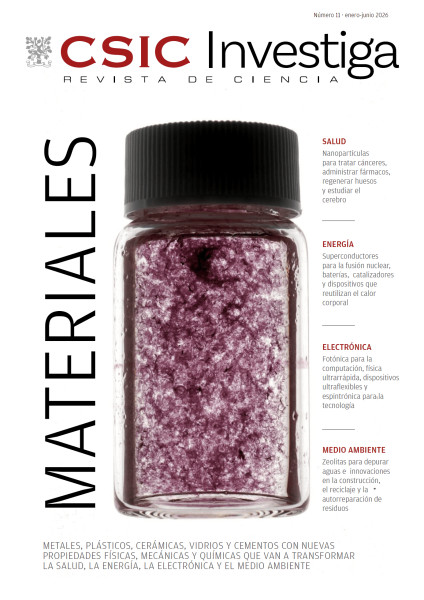



The magazine CSIC Investiga addresses advances in materials on the occasion of the 40th anniversary of the Council’s institutes dedicated to this discipline
CFM research staff participate in this special edition by authoring two articles and receiving mentions for their scientific work.
Several institutes of Materials Science and Technology within the Spanish National Research Council (CSIC), a body attached to the Ministry of Science, Innovation and Universities, are celebrating the 40th anniversary of their creation this year, and are organising a wide-ranging programme of activities aimed at bringing materials science closer to society and highlighting four decades of research, innovation and knowledge transfer that have helped position Spain among the international leaders in this field.
To mark this important anniversary, issue 11 of the popular science magazine CSIC INVESTIGA presents a selection of the research in this discipline currently being carried out at the Council, which offers innovative solutions to some of the major contemporary challenges.
The CFM’s work in CSIC Investiga
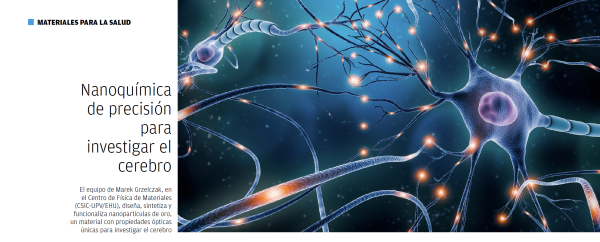
The latest issue of the scientific journal *CSIC Investiga* highlights the contribution made by our centre’s research staff. Firstly, it showcases the development of new neurotechnologies in an article by researcher Marek Grzelczak. The article details how the research group he coordinates at the CFM designs gold nanoparticles with unique optical properties which, under the umbrella of the Basque NanoNeuro Network (B3N) led by Rafael Yuste, are able to modulate neuronal activity using light and heat, thereby opening up promising therapeutic avenues of clinical relevance for the prevention and treatment of brain injuries.
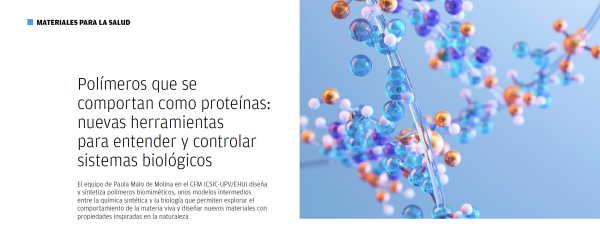
The publication includes an article by CFM researcher Paula Malo de Molina, in which she details how her team designs and synthesises biomimetic polymers that behave like proteins. These are intermediate models between synthetic chemistry and biology that make it possible to explore the behaviour of living matter and design new materials with properties inspired by nature. The creation of these new functional materials opens the door to applications as diverse as the controlled release of drugs or the modulation of cellular reactions.
The scientific work of Jon Maiz, Alberto Álvarez, Ester Verde, Silvina Cerveny, Gustavo Schwartz, Julen Ibáñez and Rubén Esteban, researchers at the CFM, is also mentioned.
The publication forms part of the programme of events marking the 40th anniversary of the Barcelona Institute of Materials Science (ICMAB-CSIC), the Madrid Institute of Materials Science (ICMM-CSIC), the Aragon Institute of Nanoscience and Materials (INMA-CSIC-Unizar) and the Seville Institute of Materials Science (ICMS-CSIC-US).
Research at these centres addresses some of the key challenges of the 21st century in three main areas: energy and sustainability, with new materials for clean energy, energy storage, recycling, decontamination and biofuels; digital technologies and computing, with advances in quantum technologies, sensors, memory devices and next-generation processors; and health, through nanoparticles, biomaterials and diagnostic and treatment systems for diseases such as cancer, neurodegenerative disorders and those associated with antibiotic resistance. Their work has also helped to attract national and international scientific talent and to foster world-class research careers.