



A functional 2D carbon allotrope combining nanoporous graphene and biphenylene segments
Carbon is one of the most versatile elements, capable of forming structures ranging from graphite to diamond. Among its two‑dimensional forms, graphene has attracted enormous interest for its strength and conductivity, but its lack of a bandgap limits its use in digital electronics, where controlled on/off switching is essential. To address this challenge, a recent study in Advanced Materials, led by Dr. Martina Corso (CFM), Prof. Aran Garcia‑Lekue (DIPC) and Dr. Ignacio Piquero‑Zulaica (CFM), presents the synthesis and characterisation of a previously unrealized 2D carbon allotrope. This material combines a graphene backbone with engineered [18]-annulene nanopores and alternating four‑ and eight‑membered rings known as biphenylene segments.
This achievement relies on atomic precision through bottom‑up synthesis. The group of Prof. Sinitskii (University of Nebraska) designed specific molecular precursors that, when deposited on gold and thermally activated in ultra‑high vacuum conditions, first assemble into 12‑pGNRs and subsequently fuse laterally. This method avoids the formation of defects typical of conventional fabrication, producing a continuous nanoporous graphene (NPG) lattice with a periodic arrangement of four‑, six‑, and eight‑membered rings, as confirmed by low‑temperature STM and nc‑AFM measurements with CO‑functionalized tips. By precisely controlling the geometry of the pores and ring segments, researchers can dictate how electrons move through the material, effectively programming its electrical and mechanical behavior.
The structure starts from 12‑atom‑wide armchair graphene nanoribbons incorporating [18]-annulene pores. These pores interrupt the hexagonal lattice, altering the material’s electronic band structure as observed by angle‑resolved photoemission spectroscopy. Depending on whether the ribbons connect through graphene‑like or biphenylene‑like junctions, the resulting allotrope can display a direct or indirect bandgap, providing a versatile platform for electronics. DFT modelling and STS show that electronic states near the bandgap are localized between the pores, suggesting that electronic behavior can be tuned by choosing the type of segment connecting them.
The introduction of pores slightly softens the material but the biphenylene units help reducing mechanical anisotropy, resulting in a more uniform response to stress. This offers an advantage for device integration when toleration to stretching or varying pressures is required.
Crucially, the nanopores act as chemically active sites. Gas‑adsorption experiments reveal a selective affinity for CO over oxygen, demonstrating the potential of these structures for highly sensitive chemical sensing given their high chemical stability when exposed to air.
Overall, this work introduces a tunable 2D carbon allotrope that unites electronic, mechanical, and chemical design at the atomic scale, opening promising avenues for next‑generation nanoelectronics, sensing devices, and functional membranes.
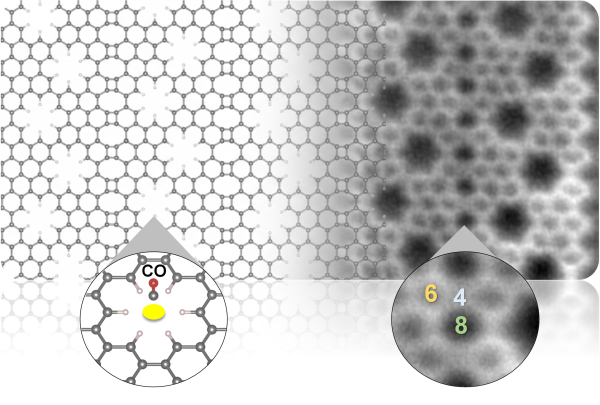
Figure: A nanoporous graphene (NPG) structure combining periodically spaced [18]-annulene nanopores and biphenylene segments. While the nanopores serve as active sites for interacting with CO molecules, the biphenylene segments induce an indirect bandgap to this semiconducting 2D material.