



Light-Induced Reorientation Transition in an Antiferromagnetic Semiconductor
Antiferromagnets, unlike ferromagnets, exhibit ordered atomic spins without generating a macroscopic magnetic moment, making them highly promising for spintronic technologies that require minimal interference between neighboring devices. However, their lack of a net magnetic moment also makes them difficult to control, necessitating new approaches for manipulating their magnetic states. In this study, we demonstrate a novel method to manipulate antiferromagnets using ultrafast optical pulses. We investigate the antiferromagnetic semiconductor CaMn2Bi2, driving it out of equilibrium using an ultrafast laser pulse. This excitation promotes electrons above the material’s energy band gap, disrupting its long-range spin order. Recent studies in nonmagnetic materials suggest that such nonequilibrium conditions can lead to metastable states distinct from the material’s equilibrium phase. Using time-resolved second harmonic generation, an advanced optical technique for tracking spin dynamics, we observe that CaMn2Bi2 enters a metastable antiferromagnetic state just 10 ps after excitation, and this state persists for at least 150 ps. Remarkably, while the material remains an antiferromagnet, its spins rotate by a finite angle—something that is thermodynamically forbidden in equilibrium and achievable only through optical excitation. This discovery reveals a new pathway for manipulating antiferromagnetic order using light, presenting exciting possibilities for ultrafast magnetic-device technologies. By leveraging light-induced transitions to metastable states, future research could explore novel spintronic applications that harness ultrafast phase transitions, further expanding the potential of antiferromagnetic materials in next-generation computing and information storage.
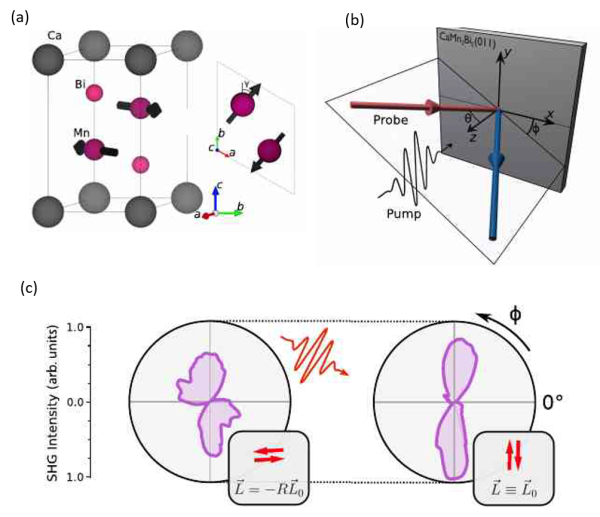
Figure: (a) Magnetic unit cell of CaMn2Bi2. The angle γ is such that the Mn spin does not lie precisely along any particular crystallographic axis. (b) Schematic of the rotational-anisotropy second harmonic generation SHG (RASHG) setup. (c) RASHG intensity at 8 K in the Pin–Pout polarization channel as a function of time for the AFM order parameter. The insets beneath the RASHG plots depict schematically the value of the Néel vector 2 ps before and 12 ps after photoexcitation.