



Nuclear Quantum Effects on the Dynamics of Bulk Water and Supercooled Aqueous Solutions
Water is far more than a passive solvent. Its extraordinary properties (from its anomalous density maximum near 4 °C to its incomparable capacity to solvate biomolecules) arise from the dynamic hydrogen-bond network, whose quantum-mechanical character remains only partially understood. At the heart of this network lie nuclear quantum effects (NQEs): phenomena such as zero-point energy, proton delocalization, and quantum tunneling that cause the lightest atomic nuclei to behave in ways that classical physics cannot capture. The clearest experimental signature of NQEs is the marked difference in dynamics between light water (H₂O) and heavy water (D₂O), in which replacing hydrogen with the heavier deuterium slows down molecular motion. Yet a fundamental question has remained open: do biologically relevant environments, particularly charged solutes such as amino acids, modify the magnitude of NQEs, and if so, by how much?
To address this question, Jorge H. Melillo and Silvina Cerveny (DIPC/CFM, San Sebastian) used broadband dielectric spectroscopy and differential scanning calorimetry on three isotopically distinct forms of water: ordinary H₂O, deuterated D₂O, and oxygen-18-labeled H₂¹⁸O. By comparing these three isotopologues over a wide temperature range, from ambient conditions down into the deeply supercooled regime near 200 K, they cleanly disentangled mass effects from genuine quantum contributions. A key control result is that replacing the common ¹⁶O with the heavier ¹⁸O isotope produces only a ~5% slowdown in relaxation dynamics, confirming that H₂O and H₂¹⁸O are quantum-mechanically equivalent and that the much larger H₂O/D₂O difference is authentically quantum in origin. In bulk water at 290 K, the relaxation-time ratio τ(D₂O)/τ(H₂O) is ≈1.3, in excellent agreement with state-of-the-art path-integral molecular dynamics simulations.
The most striking findings emerge in the supercooled regime, where the dynamics slow dramatically, and the influence of the local environment becomes decisive. In aqueous solutions of a neutral polymer (poly (vinyl methyl ether)), the isotope ratio increases moderately to ~ 2 near 200 K. However, in lysine solutions, a basic amino acid whose side chain carries a positive charge under physiological conditions, the fast-water relaxation ratio reaches ~4, representing a threefold enhancement of NQEs relative to bulk water. This amplification is attributed to the strong electrostatic interactions between the charged lysine residues and the surrounding water molecules, which tighten and restructure the hydrogen-bond network, thereby making quantum tunneling and zero-point fluctuations significantly more influential.
These results have important implications on two fronts. First, they demonstrate that biological macromolecules can actively tune the quantum character of the water that hydrates them, a finding relevant to understanding enzymatic catalysis, protein folding, and other processes in which proton transfer plays a key role. Second, they provide a rigorous experimental example for the growing field of quantum-accurate molecular modeling: any computational method describing water in biological environments must correctly reproduce not only the bulk isotope ratio but also its environment-dependent enhancement. By establishing a clear, quantitative picture of how NQEs vary with temperature and chemical context, this work opens a new window onto the quantum life of water.
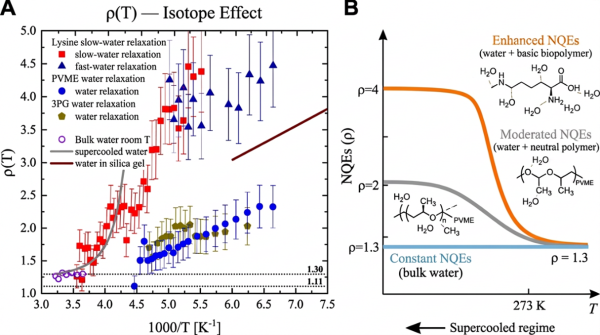
Figure Caption. (a) Temperature dependence of the isotope ratio ρ = τ(D₂O)/τ(H₂O) calculated from the relaxation times of different isotopes. (b) Schematic summary of the temperature-dependent nuclear quantum effects (NQEs) measured in this study, expressed as the isotope ratio ρ = τ(D₂O)/τ(H₂O). In bulk water (light blue), ρ remains constant at ~1.3 across the liquid range. In supercooled solutions of a neutral polymer (gray), ρ increases moderately to ~2. In supercooled solutions of the basic amino acid lysine (orange), ρ reaches ~4 revealing a threefold amplification of NQEs driven by the charged biological environment.