



Symmetry-Broken Ground State and Phonon-Mediated Superconductivity in Kagome CsV3Sb5
The non-magnetic Kagome metal CsV3Sb5 has garnered significant attention due to the intricate interplay between charge density wave (CDW) order and superconductivity. However, determining its true low-temperature thermodynamic ground state has remained an outstanding structural puzzle. Like many prototypical CDW systems, this material is dynamically unstable at the harmonic level. To resolve this, we go beyond standard Born-Oppenheimer energy analysis by incorporating the critical contributions of ionic quantum fluctuations and entropy through the stochastic self-consistent harmonic approximation (SSCHA). This approach allows us to map the free-energy landscape and identify three competing metastable structural reconstructions: the TrH (triangular-hexagonal), π-TrH, and 4TrH phases.
These three phases differ only in the out-of-plane stacking of the vanadium layers, allowing us to identify the π-shift between nearest-neighbor layers as the true ground state. This results in a direct competition between 2x2x2 and 2x2x4 modulated phases. Crucially, this finding completely reconciles conflicting experimental measurements regarding electronic anisotropy. While an ordered π-shift between vanadium layers intrinsically breaks rotational symmetry and induces microscopic anisotropy, the negligible energy differences between these stacking sequences—combined with the presence of three-fold related domains—promote stacking disorder in real samples. This disorder restores macroscopic symmetry, explaining the apparent isotropic behavior seen in transport experiments.
Furthermore, by fully characterizing the CDW phase and its vibrational modes, we elucidate the mechanism behind the material’s superconducting state. By computing the electron-phonon matrix elements in tandem with fully anharmonic quantum phonons, we accurately reproduce a superconducting critical temperature (TC) in excellent agreement with experimental data. This provides evidence that superconductivity within the CDW phase of CsV3Sb5 is phonon-mediated.
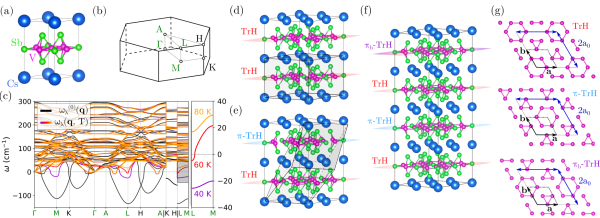
Figure: Structural and dynamical properties of CsV3Sb5. (a) Atomic structure of the pristine high-symmetry phase. (b) Visualization of the Brillouin zone of the high-symmetry phase and its high-symmetry points. (c) Harmonic and SSCHA Hessian phonon spectra of the high-symmetry phase calculated at 40, 60 and 80 K. Imaginary modes are depicted with negative values. The high symmetry wave vectors calculated explicitly and later used for the Fourier interpolation are highlighted in green. (d),(e),(f) Atomic structure of the TrH, π-TrH and 4TrH phases. In the case of TrH and π-TrH, their respective primitive cells are highlighted. (g) Visualization of the out-of-plane shift of the vanadium TrH layers that distinguish the emerging low-symmetry metastable phases.