


PhD Thesis Defense | Irene Carbajo de la Guerra
Constant-pH simulations of biomolecular systems: from proteins to supramolecular assemblies
June 19, 11:00
CFM Auditorium
Candidate: Irene Carbajo de la Guerra
Supervisors: Ivan R. Sasselli and Gabriel Molina Terriza
SUMMARY
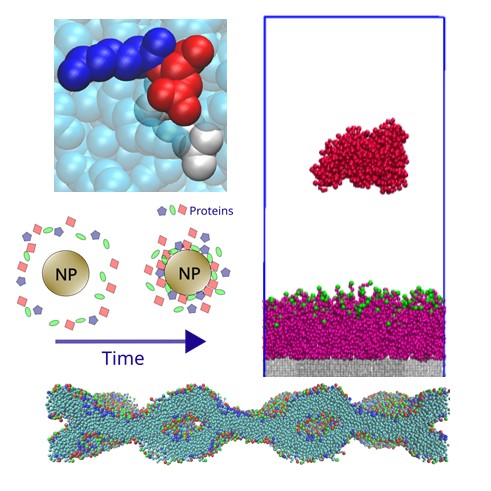
pH is a key regulator of biomolecular behaviour, influencing structure, dynamics, interactions, and self-assembly through changes in protonation state. Constant-pH molecular dynamics (CpHMD) provides a powerful approach to capture these effects by allowing protonation states to respond dynamically to their environment. In this work, CpHMD simulations are applied across multiple length scales and levels of complexity. Atomistic simulations of the membrane protein CD81 reveal the coupling between protonation and conformational changes. Coarse-grained studies of human serum albumin and transferrin highlight the interplay between charge distribution, structural stability, and environmental conditions. Protein interactions with functionalised PEG polymer brushes are explored, showing that negatively charged polymers reduce protein adsorption and, consequently, the formation of the problematic protein corona. Finally, the self-assembly of RGD peptide mimetics is investigated, demonstrating that, while constant-pH simulations show limited sensitivity to environment-driven protonation effects in these systems, standard simulations reproduce supramolecular behaviour and confirm that key bioactive motifs are preserved. Overall, this work provides a multiscale description of pH-dependent phenomena in biomolecular systems and assesses the applicability of constant-pH methodologies across different interaction regimes.