


PhD Thesis Defense | Martín Molezuelas
 Characterization Methods Based on Mie Scattering
 Characterization Methods Based on Mie Scattering
December 18, 11:00
CFM Auditorium
Candidate: Martín Molezuelas
Supervisor: Gabriel Molina Terriza
SUMMARY
We detail a theoretical and experimental work on the scattering of structured light by micrometric spheres. A theoretical characterization model based on this subject is developed, and it is used for the measurement of the properties of scatterers made of different materials and under different conditions.
Hand-drawn schematics of a experimental optical setup proposed in this thesis, from a top-down perspective.
The theoretical study is based on Generalized Lorenz-Mie Theory (GLMT). We model focused light with angular momentum, decomposing its electromagnetic field into a basis of vector multipoles with spherical symmetry. In terms of these multipoles, the field scattered by any sphere can be described analytically. The decomposition is also carried out in terms of the helicity of light. On the scattering spectrum, we find several features that can be used to determine the properties of the spheres. One type of feature we find are Mie resonances, which depend sensitively on the morphology of the scatterer. Their excitation strongly depends also on the angular momentum of light. Another spectral feature appears as an oscillatory pattern, which appears when using tightly focused light and micrometric spheres.

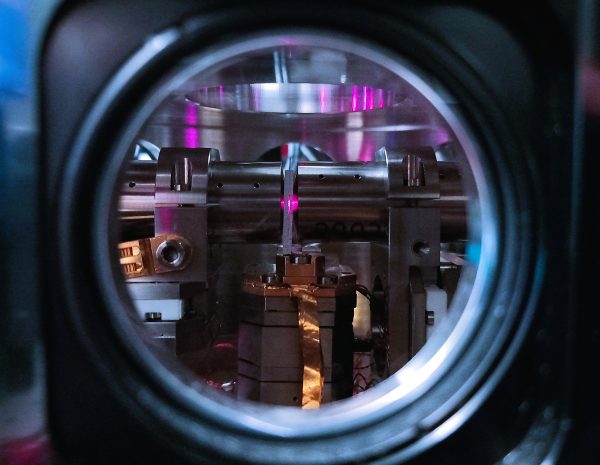
Interior of the cryostat chamber in which the scattering measurements detailed in this thesis are performed, photographed from one of the the chamber windows.
Regarding the experimental part, we built a setup capable of generating light with arbitrary angular momentum, focusing it onto micrometer-sized spheres, and then retrieving the backscattered field, for a tunable range of wavelengths in the near-infrared (NIR). We used this setup to search for Mie resonances and control them by varying the incident angular momentum. We performed a characterization of the oscillations present in the backscattering spectra of several spheres of known diameter, which allows us to retrieve their individual refractive index with precision far beyond the wavelength scale. We also analyzed the evolution of this oscillatory pattern with the temperature and pressure of the scatterer’s environment, for spheres made of different materials. Our results suggest that, applying our methods, it is possible to develop monitoring techniques of the properties of spheres under changing environmental conditions, in a precise and non-invasive way.