



PhD Thesis Defense | Pelayo Marín Villa
 Structure and Dynamics of Methylammonium Lead Iodide across Physical Space
 Structure and Dynamics of Methylammonium Lead Iodide across Physical Space
December 10, 9:00
CFM Auditorium
Candidate: Pelayo Marín Villa
Supervisor: Félix Fernández Alonso and Kacper Druzbicki
SUMMARY
This thesis examines the structure and dynamics of the hybrid perovskite MAPbI3, a highly promising photovoltaic material whose intrinsic instability remains a major barrier to commercial deployment. Using a multidisciplinary approach -combining neutron and synchrotron X-ray diffraction, inelastic neutron scattering, calorimetry, and first-principles modeling- the work elucidates the atomistic mechanisms governing its stable and metastable phases. A critical reassessment of existing low-temperature structural models shows that the crystallographic Pnma phase fails to reproduce key vibrational spectra and heat-capacity data. A systematic exploration of the potential-energy landscape yields forty-nine candidate structures, nine of which are mechanically stable and exhibit reduced symmetry around the methylammonium cation. These models reconcile spectroscopic observables and successfully capture features such as the negative thermal expansion observed during the transition from the low-temperature, cation ordered phase to the high-pressure, cation disordered cubic phase. The thesis also reports the first inelastic neutron-scattering measurements above 1 GPa, revealing the emergence of a phase with glass-like orientational disorder of the organic cation. Overall, the results provide a robust foundation for the rational design of more stable photovoltaic perovskites and clarify the role of local distortions and hydrogen-bond geometries in governing the structural evolution of MAPbI3.
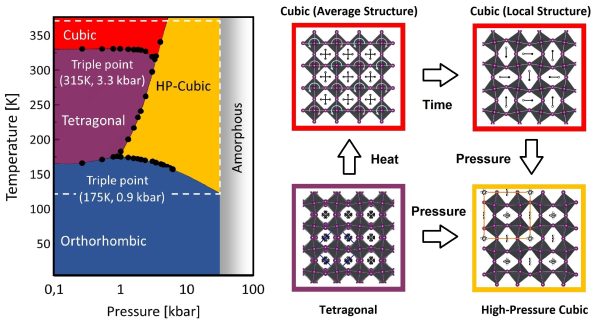
(Left) P−T phase diagram of MAPbI3. (Right) Selected projections of the structures of these phases.