



Coherent Subgap Transport in Spin-Split Josephson junctions
Transport in superconductor–insulator–superconductor (SIS) junctions is strongly governed by the barrier transparency. In the tunnelling limit (opaque barrier), transport is dominated by quasiparticles and no supercurrent is expected; in this regime, differential conductance (dI/dV) directly probes the density of states, revealing a clear gap below the sum of the superconducting gaps of the electrodes. As the barrier becomes more transparent, additional processes emerge: electrons can undergo Andreev reflection, being converted into holes at the interface. Multiple Andreev reflections (MAR) enable subgap transport, giving rise to characteristic resonances in dI/dV at well-defined voltages. When one of the superconductors (S) is coupled to a ferromagnetic insulator (F), spin degeneracy is lifted, and the subgap spectrum is expected to reflect this splitting, according to the theory
Among the platforms that host such interactions, hybrid junctions based on the ferromagnetic insulator europium sulfide (EuS) and the superconductor aluminum (Al) are particularly promising. The exchange interaction at their interface is known to lift spin degeneracy in the superconducting electrode, inducing a Zeeman-like splitting that can be resolved by transport spectroscopy. While theory has predicted that this interaction should also lift the spin degeneracy of the Andreev bound state (ABS) spectrum, experimental evidence has remained largely unexplored.
In this work, led by CFM researchers in collaboration with colleagues from Instituto de Ciencia de Materiales de Madrid and Instituto de Física de Materiales Nicolás Cabrera, the first experimental evidence of coherent subgap transport in hybrid ferromagnetic-insulator/superconductor structures is reported, specifically in EuS/Al-based devices. The Andreev bound state (ABS) spectrum is resolved, revealing multiple Andreev reflections (MAR) up to high orders (n > 3) and clear spin splitting for odd n, in agreement with theoretical predictions. In addition, a Josephson current is observed, demonstrating that superconducting correlations persist despite the exchange interaction induced by the ferromagnet.
Both the Josephson current and the MAR spectrum are characterized as a function of temperature and magnetic field, confirming singlet superconducting pairing in Al. Theoretical modelling indicates that a significant fraction of conduction channels exhibit high transparency (τ > 0.3), accounting for the measurable Josephson current. This work establishes EuS/Al junctions as a versatile platform for studying subgap transport, Josephson coupling, and spin-polarized superconducting phenomena.
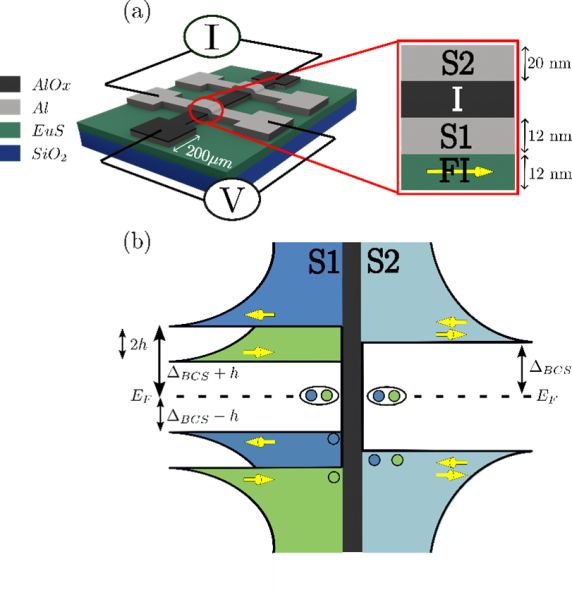
Figure 1. (a) Device and geometry description. (b) Expected density of states of the junction. The magnetic proximity effect in the left electrode manifests as a spin split density of states.
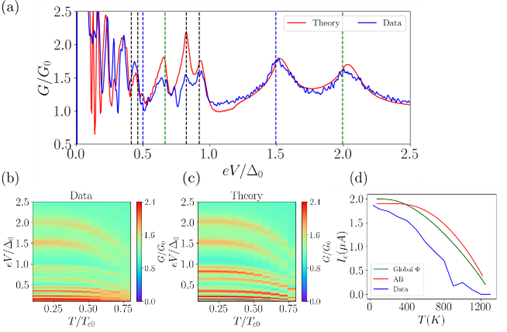
Figure 2. (a)Full conductance spectrum of the device, showing the subgap structure related to the MARs (b) and (c) Measured and theoretical simulation of the MAR spectrum under temperature evolution. (d) Josephson supercurrent comparison between data and theoretical predictions.