



Facile Van der Waals hBN Encapsulation and Stabilization of Perovskite Quantum Dots Emission
A new collaborative study between the CFM “Nanomaterials and Spectroscopy Group”, the DIPC “Nanophotonics of 2D Materials Group” and the group from the University of Technology Sydney demonstrates a simple and highly effective strategy to overcome one of the key barriers limiting the use of perovskite quantum dots in quantum photonics: long-term photostability at the single-emitter level. Researchers report a facile van der Waals encapsulation of all-inorganic perovskite quantum dots using hexagonal boron nitride (hBN), enabling robust and stable room-temperature single-photon emission.
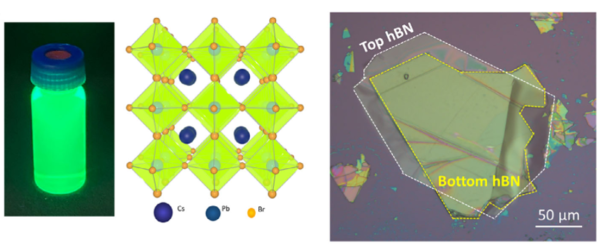
By encapsulating perovskite quantum dots between thin hBN layers without any post-synthetic chemical processing, the team achieves strong physical isolation from the environment while preserving pristine optical properties. Compared with unprotected quantum dots, the hBN-encapsulated structures exhibit nearly 50-fold higher excitation power tolerance, dramatically suppressed blinking and photobleaching, and exceptional spectral stability. Crucially, the encapsulation enables clear photon antibunching at room temperature, confirming stable single-photon emission from individual quantum dots.
This work provides a scalable and materials-tolerant route to stabilizing perovskite quantum dots for demanding quantum-light applications. By combining the outstanding optoelectronic properties of perovskites with the protective capabilities of two-dimensional materials, the study opens new opportunities for integrating quantum dots into nanophotonic devices, optical cavities, and future quantum technologies.