



Peptide-guided self-assembly: fabricating tailored spiral-like nanostructures for precise inorganic templating
Self-assembling peptides represent a frontier in nanomaterial fabrication, offering unprecedented control over hierarchical structures. However, creating spiral nanoarchitectures—which mimic natural systems and hold promise for optical and catalytic applications—has remained challenging due to fabrication limitations and lack of precise structural control.
This work demonstrates that two fusion peptide sequences derived from the SARS-CoV-2 Spike protein can spontaneously form well-defined nanostructures when assembled at air-water interfaces under controlled surface compression. AFM imaging was instrumental in revealing how subtle differences in amino acid composition yield fundamentally different morphologies. The sequence richer in hydrophobic residues (Leu, Ile, Val) generates long, straight fibrils with minimal curvature, reflecting a high persistence length (Lp ≈ 3.2 μm). Although this sequence exhibits a less extensive β-sheet content, its more homogeneous secondary structure produces a continuous hydrogen bonding network that confers rigidity. In contrast, the sequence containing a greater proportion of charged and polar residues (Lys, Asp, Gln) adopts a higher β-sheet content, yet electrostatic repulsion and solvation effects introduce local disruptions that act as flexible hinge points along the fibrils. The resulting lower persistence length (Lp ≈ 0.12 μm) allows these fibers to curve and fold upon themselves, forming intricate spiral-like nanostructures.
AFM analysis further demonstrated that by systematically varying surface pressure, spiral characteristics such as curvature angle and inter-fiber spacing can be precisely tuned. Complementary neutron reflectometry and interfacial shear rheology measurements revealed a fluid-to-solid transition at, where the fibril network develops gel-like elastic behavior driven by molecular packing at the interface.
The most significant application potential lies in the ability to use these peptide spirals as templates for metallic replicas. Using aqueous metal reduction methodology with HAuCl₄, followed by UV/O₃ treatment, the team successfully created gold nanostructures that replicate the original spiral morphology. XPS analysis confirmed complete peptide removal and successful gold incorporation, yielding pure inorganic structures with sub-10 nm features. This fabrication approach offers several advantages over conventional lithographic techniques: it operates at low energy input, provides excellent structural uniformity across large areas, and enables precise control over curvature and inter-fiber spacing. The methodology’s versatility extends to different inorganic species, opening pathways for tailored plasmonic materials with unique optical, electronic, and catalytic properties.
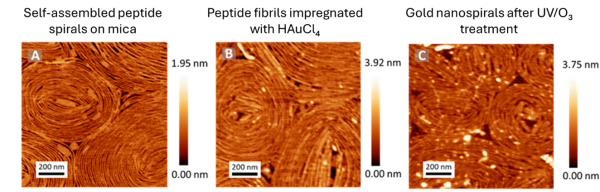
Figure: A) pristine FP2 peptides at 20 mN m−1 surface pressure onto mica substrates, B) after 30 min immersion into the HAuCl4 solution, and C) after the subsequent UV/O3 degradation treatment.