



Thermally-induced nickelocene fragmentation and one-dimensional chain assembly on Au(111)
Controlling the adsorption, transformation, and assembly of molecules on surfaces is a central goal in nanoscience, because it enables the fabrication of functional structures with tailored electronic, chemical, and magnetic properties. In this work, nickelocene (NiCp₂) deposited on Au(111) is investigated using low-temperature scanning tunneling microscopy (STM), scanning tunneling spectroscopy (STS), and density functional theory (DFT).
A key result is that the substrate temperature during deposition determines two very different regimes. When nickelocene is deposited at low temperature, the molecules remain intact and adsorb preferentially at herringbone elbows and step edges, where they can also form ordered islands. By contrast, when the molecules are deposited on Au(111) held at room temperature, nickelocene dissociates and produces two main fragments: NiCp species and isolated Cp rings.
The most significant finding is that the NiCp fragments self-assemble into one-dimensional chains aligned along specific crystallographic directions of the Au(111) surface. At higher coverage, these chains can further organize into larger triangular patterns. The combined experimental and theoretical analysis shows that this assembly is governed by the adsorption of the Ni atom on FCC hollow sites of the gold surface, together with steric effects between neighboring cyclopentadienyl ligands. The study also identifies two distinct dimer configurations of the NiCp fragments, one of which is stabilized by the incorporation of a gold adatom between the fragments.
From the electronic and magnetic point of view, the work demonstrates that the dissociation fragments lose the magnetic character of intact nickelocene because of their strong hybridization with the Au(111) substrate. This highlights the active role of the surface not only in molecular dissociation, but also in determining the dimensionality, stability, and functionality of the resulting nanostructures. More broadly, the study establishes thermally induced fragmentation as an effective route to engineer surface-confined one-dimensional architectures derived from metallocenes, opening new possibilities for on-surface synthesis and for future exploration of low-dimensional magnetic systems on less quenching substrates.
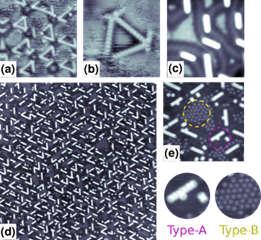
Figure: STM images showing the thermal dissociation of nickelocene on Au(111) and the emergence of new surface nanostructures. After deposition at room temperature, two types of fragments appear: NiCp species, which self-assemble into one-dimensional chains and triangular motifs, and Cp fragments, which form more isotropic aggregates. This figure summarizes the central result of the work.