



What is the maximum critical temperature of conventional superconductors at ambient pressure?
Superconductivity has fascinated scientists for over a century. Raising the superconducting critical temperature is essential for real-world applications, from magnetic resonance imaging to quantum technologies. Yet a key question remains: how high can the superconducting temperature really go at ambient pressure?
In a recent study focused on conventional superconductors, researchers at the Centro de Física de Materiales (CFM-MPC) address this question using a combination of first-principles calculations and machine learning. Rather than focusing on a few selected materials, researchers explored conventional superconductivity on an unprecedented scale by screening 100 million compounds. This data-driven approach allows researchers to move beyond individual discoveries and identify the fundamental principles that govern superconductivity.
At the heart of conventional superconductivity lies the interaction between electrons and vibrations of the atomic lattice, known as phonons. Intuitively, one might expect that strengthening the interaction between phonons and electrons would lead to higher superconducting temperatures. However, their results reveal a fundamental constraint: these two ingredients cannot be optimized simultaneously. Materials with very high vibrational frequencies tend to have weak electron–phonon coupling in most cases. This intrinsic trade-off acts as a bottleneck, limiting how far superconductivity can be pushed.
By systematically analyzing this balance across 20,000 metals using ab initio calculations, researchers find that the maximum achievable superconducting temperature at ambient pressure is likely around 100~120 K. Some hydrogen-rich compounds come close to this limit in theory, with predicted transition temperatures above that of liquid nitrogen. However, these promising candidates come with a major caveat: they are typically thermodynamically unstable, making them extremely difficult to synthesize and maintain under normal conditions.
This insight helps explain a long-standing puzzle. While record-breaking superconductors have been discovered at high temperatures, they always require extreme pressures. These results suggest that, under ambient pressure, conventional superconductivity faces a much stricter ceiling. Although fundamental physical laws do not strictly forbid room-temperature superconductivity, achieving it at ambient pressure through conventional electron-phonon mechanisms appears highly unlikely in practice. This work provides a clearer roadmap for future research, pointing toward the need for new materials, unconventional mechanisms, or entirely different physical paradigms.
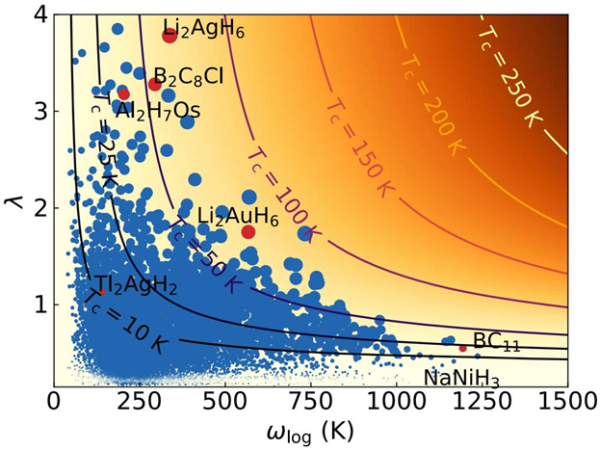
Figure: Trade-off between electron phonon coupling λ and logarithmic average frequency ωlog