



One ionic liquid, two structural regimes, multiple functionalities
Understanding how ionic liquids organize within polymer matrices is essential for designing multifunctional soft materials for sensing, actuation, and energy-related applications. In a recent study published in Advanced Materials, the team provide a complete multiscale picture of magnetic ionic liquid distribution inside electroactive fluoropolymer composites. They investigated composites based on the ferroelectric copolymer P(VDF-TrFE) and the magnetic ionic liquid [Bmim][FeCl4]. To resolve their complex internal organization, they combined small-angle neutron scattering (SANS) with advanced cryogenic electron microscopy techniques, including cryo-focused ion beam tomography and cryo-HAADF-STEM elemental mapping. Their results reveal that the ionic liquid selectively occupies the polymer’s unconfined amorphous phase, where it forms nanodomains with characteristic sizes of 10-12 nm while leaving the crystalline lamellae and the highly electroactive β-phase unaffected. This preservation of the polymer crystalline structure is crucial for maintaining the material’s electroactive functionality. Above a critical ionic liquid concentration of approximately 20 wt.%, the amorphous polymer phase becomes saturated and excess ionic liquid microphase-separates into interconnected micrometer-sized pores. Cryogenic 3D tomography demonstrates that these pores form a percolated network throughout the material. The study establishes a direct connection between this hierarchical structure and the macroscopic properties of the composites. Ionic liquid confinement within the amorphous phase drives a dramatic increase in ionic conductivity while preserving mechanical integrity, whereas the interconnected microporous network enhances the magnetoelectric and magnetomechanical response. Importantly, the work demonstrates that processing conditions, particularly solvent evaporation kinetics, provide an effective route to tailor nano- and microstructure independently. These findings offer new guidelines for engineering polymer/ionic liquid composites with tunable multifunctional properties for future flexible sensors, actuators, and energy devices.
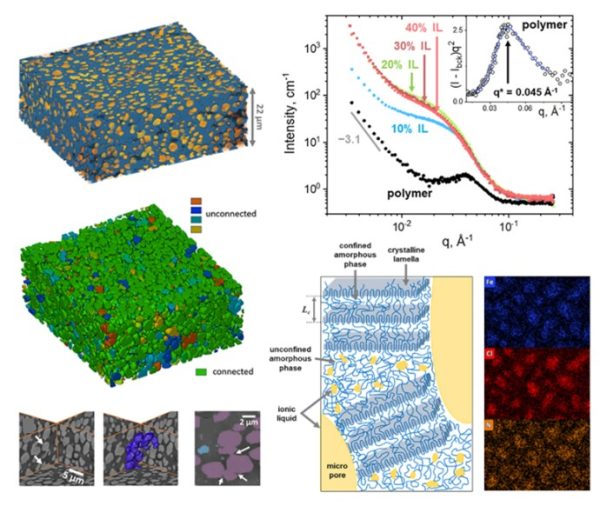
Figure: Multiscale characterization of P(VDF-TrFE)/[Bmim][FeCl4] composites combining cryo-FIB/SEM tomography, neutron scattering, and cryo-HAADF-STEM/EDX reveals the hierarchical organization of the ionic liquid within the polymer matrix. The ionic liquid forms interconnected micrometer-sized porous networks at high concentrations while simultaneously creating 10-12 nm nanodomains within the amorphous polymer phase, establishing the complex micro- and nanostructure governing the functional properties of the composites.