



Single-bond dual dynamics: temperature-gated associative and dissociative exchange of disulfides in a sustainable covalent adaptable network
Developing recyclable polymer networks that combine durability with sustainability remains a central challenge in materials science. In a recent article in Chemical Engineering Journal, researchers at the Materials Physics Center (CFM-MPC) demonstrate that a single disulfide bond can exhibit two distinct exchange mechanisms, associative and dissociative, controlled exclusively by temperature, in a sustainable covalent adaptable network (CAN) without additives or complex formulations.
Thermoset polymers are widely used in industry due to their mechanical robustness, but their inability to be reprocessed or recycled poses significant environmental challenges. CANs address this limitation by incorporating reversible covalent bonds, enabling reprocessability while maintaining structural integrity. Among these, disulfide bonds stand out for their responsiveness and availability, though controlling multiple exchange pathways within a single bond type remains difficult.
Here, the team synthesized a disulfide-based CAN via a green, scalable oxidation process using a low-cost commercial monomer. Combining mechanical, thermal, and spectroscopic techniques, including dynamic mechanical analysis, stress relaxation, creep testing, broadband dielectric spectroscopy, and Raman and FTIR spectroscopy, they reveal two clearly separated and reversible dynamic regimes. Below 365 K, the network undergoes associative disulfide metathesis, preserving cross-link density. At higher temperatures, thermal S-S bond cleavage dominates, leading to a dissociative mechanism. This temperature-gated duality translates directly into material performance: the network self-heals at room temperature under mild pressure, can be fully mechanically recycled at 393 K with recovery of its original viscoelastic and tensile properties, and remains stable under air, light, and humidity.
This work demonstrates that minimal molecular design can deliver sophisticated dynamic behavior, highlighting the ability of CFM-MPC researchers to bridge polymer physics, dynamic covalent chemistry, and sustainable materials design.
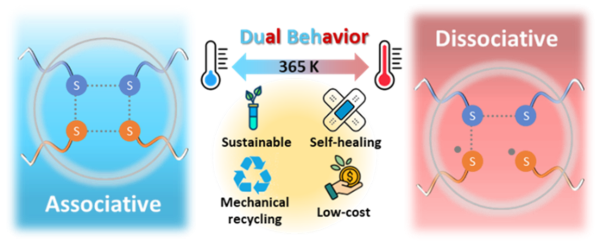
Figure: Disulfide-based covalent adaptable network (CAN) showing temperature-gated dual dynamics: associative exchange below 365 K and dissociative above. This single-bond system enables room-temperature self-healing and full recyclability, using a sustainable, low-cost monomer.