Squeezed light with spatial structure for sensing
Quantum-enhanced metrology with squeezed states for improved sensitivity at the nanoscale.
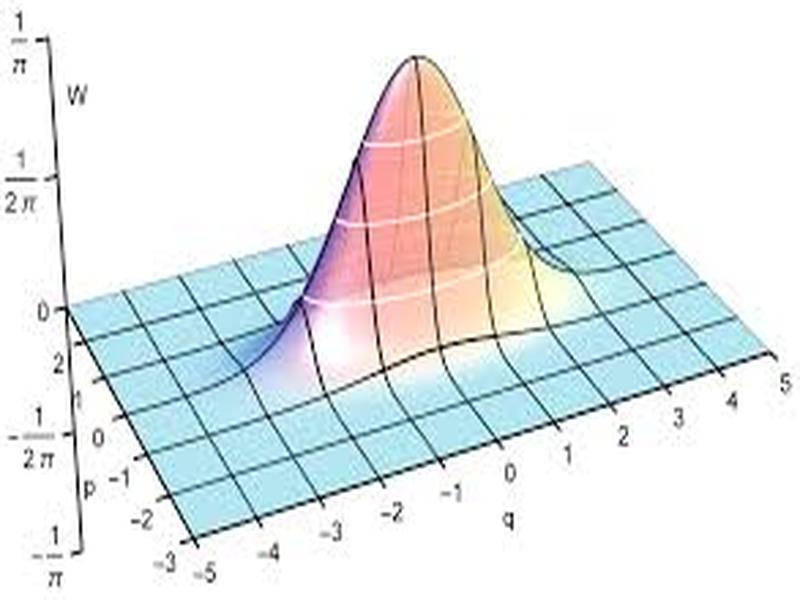
We study the generation of squeezed vacuum states with different spatial modes, particularly those carrying orbital angular momentum (Laguerre–Gaussian modes). Our research follows two main directions: the generation of vacuum squeezed light via the parametric down-conversion method, and the creation of high-order spatial modes.
Squeezed light is a nonclassical state of the electromagnetic field in which the quantum uncertainty (or noise) of one field quadrature—such as phase or amplitude— is reduced below the shot-noise limit, at the expense of increased noise in the conjugate quadrature, in accordance with Heisenberg’s uncertainty principle. This redistribution of quantum fluctuations enables precision measurements beyond the standard quantum limit.
In our experiments, we generate squeezed light through parametric down-conversion in a nonlinear crystal. In this process, a strong pump field interacts with the nonlinear medium and spontaneously splits pump photons into pairs of lower-energy photons whose combined energy equals that of the pump. These newly generated photons are correlated in space, time, frequency, and polarization. Such correlations effectively “squeeze” the quantum fluctuations—producing vacuum squeezed light when only the pump is present, or bright squeezed light when the crystal is seeded with a beam at the same frequency as the down-converted light.
In addition to conserving energy and linear momentum, the down-conversion process also conserves angular momentum. This means that any orbital or spin angular momentum carried by the pump photons is transferred to the down-converted photons. For example, when the pump beam carries orbital angular momentum—such as in a Laguerre–Gaussian mode—the generated photon pairs inherit this property in a correlated manner.
To generate squeezed states with different spatial structures, we shape the pump beam using a spatial light modulator (SLM), which modifies the phase of the wavefront of the incoming beam. This approach allows us to engineer and study quantum light fields with tailored spatial and angular momentum properties.
Keywords: squeezed light, spatially structured light, orbital angular momentum (OAM), spontaneous parametric down-conversion (SPDC), quantum-enhanced sensing.