


From Yu–Shiba–Rusinov states to Josephson transport in a single molecular junction
How does electrical transport evolve when a magnetic impurity becomes part of an increasingly transparent superconducting junction? In our new work in Nature Communications, we address this question at the ultimate limit of a junction assembled atom by atom.
Magnetic atoms coupled to superconductors generate localized excitations inside the superconducting energy gap known as Yu–Shiba–Rusinov (YSR) states. At the same time, sufficiently transparent junctions between two superconductors support multiple Andreev reflections (MAR), in which electrons and holes undergo successive reflections and transfer charge across the junction. Both effects are well established individually, but their interplay at the atomic scale remains considerably less explored.
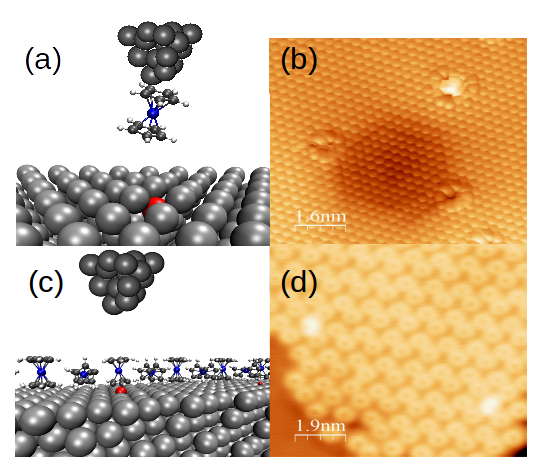
We construct a superconducting molecular junction using a nickelocene molecule positioned on top of an Fe atom on Pb(111). A superconducting scanning tunneling microscope tip is then approached towards the molecule, allowing the junction transparency to be changed continuously while maintaining essentially the same microscopic system.
This tunability reveals a remarkable evolution of the transport mechanism. In the low-transparency tunneling regime, the spectra are dominated by conventional spectroscopy of YSR states. As the tip approaches and the junction becomes more transparent, these magnetic bound states begin to participate directly in multiple Andreev reflection processes. The resulting YSR-assisted MAR produces characteristic shifts of the usual MAR thresholds, asymmetric spectral features, and pronounced odd–even effects. Increasing the transparency still further eventually brings the junction into a regime where a Josephson current can flow.
The experiment therefore follows, within a single nanoscale junction, the continuous progression going from electron tunneling through YSR states, next electron transport by YSR-assisted Andreev reflections, and finally Josephson currents at the large conductance regime.
Theory provides a microscopic interpretation of this evolution. Calculations combining superconducting transport, exchange coupling and junction transparency reproduce the principal experimental signatures. Density-functional theory further shows that the nickelocene–Fe complex has an antiferromagnetic ground state while retaining a residual spin on the Fe atom, which is responsible for the YSR resonances.
Thus, this work shows that magnetic and superconducting transport are not separate phenomena. At sufficiently high junction transparency, localized magnetic states can become active intermediate states in coherent charge-transfer processes between superconductors. Atomic-scale junctions therefore provide a controlled platform in which magnetism, Andreev physics and Josephson transport can be continuously connected and tuned within the same microscopic device.
Reference: C. Mier et al., “Yu-Shiba-Rusinov-assisted Andreev transport in a molecular junction between superconductors,” Nature Communications (2026), DOI: 10.1038/s41467-026-76478-4.