We uncover how anharmonic lattice dynamics drive charge order and enable phonon-mediated superconductivity in the kagome metal CsV₃Sb₅
Kagome metals have emerged as a fascinating platform to explore the interplay between charge order, superconductivity, and topology. Among them, CsV3Sb5 has attracted particular attention, yet the microscopic nature of its charge-density wave (CDW) and its relation to superconductivity have remained open questions.
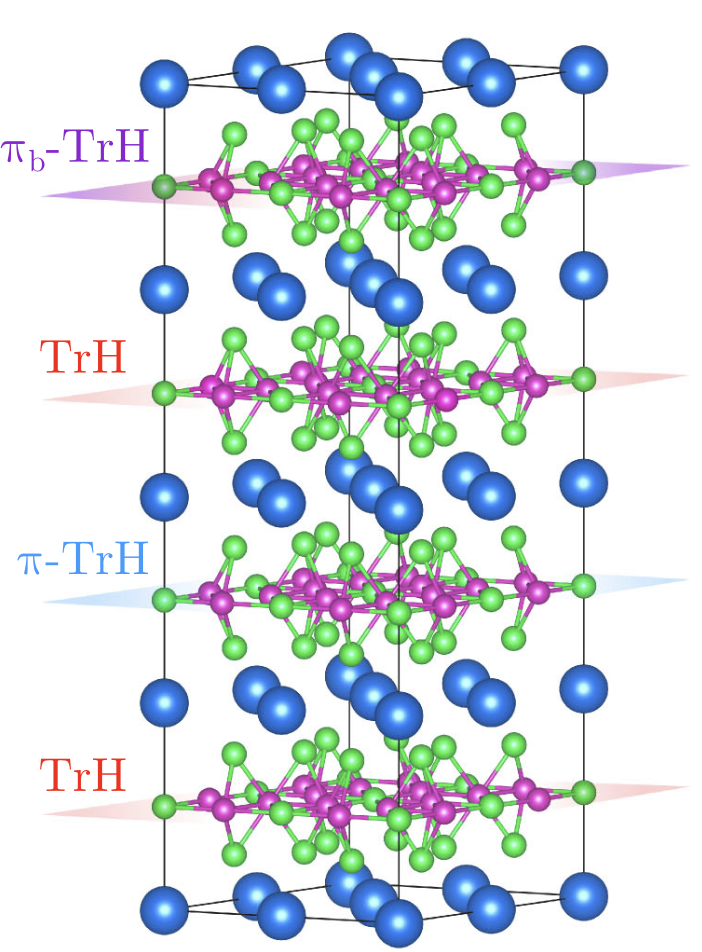
In our recent works (Physical Review Letters 136, 206401 (2026) and Nature Communications 17, 4817 (2026)), combining advanced first-principles calculations with anharmonic lattice dynamics, we provide a unified picture of these phenomena. We show that the CDW originates from a soft phonon instability, which is confirmed by the inelastic x-ray scattering experiments of our collaborators in Karlsruhe (Germany), and leads to a reconstruction of the vanadium kagome layers into a triangular–hexagonal pattern. Importantly, several stacking configurations of these layers are nearly degenerate in energy, resulting in competing phases and promoting stacking disorder in real materials. This resolves the long-standing puzzle of why transport measurements do not detect macroscopic symmetry breaking, despite the presence of a symmetry-broken ground state.
Our calculations further reveal that superconductivity arises naturally within this CDW phase. By explicitly including anharmonic effects in both the lattice dynamics and electron–phonon interaction, we obtain a superconducting critical temperature in agreement with experiments, demonstrating that pairing is phonon-mediated.
Altogether, our results show that anharmonic lattice effects are essential to understand kagome metals: they drive the formation of the CDW, control its complex structural landscape, and ultimately enable superconductivity. These works highlight the key role of lattice dynamics in shaping the quantum phase diagram of these materials and provides a robust framework to investigate related systems.
More information in the PRL and Nature Communications papers published.