
During the past 50 years, physical-chemical properties and processes occurring at the surface of solids have been investigated with Surface Science techniques in an infinite variety of crystalline materials. Most studies were carried out at surfaces oriented along high-symmetry directions, and much less on low-symmetry surfaces, also called vicinal surfaces. These are defined by high-symmetry nano-facets (called terraces), separated by atomic-height steps. Since terraces and steps feature distinct atomic coordination and electronic properties, at a vicinal surface a peculiar one-dimensional nanoscale pattern is defined that strongly influences surface phenomena.

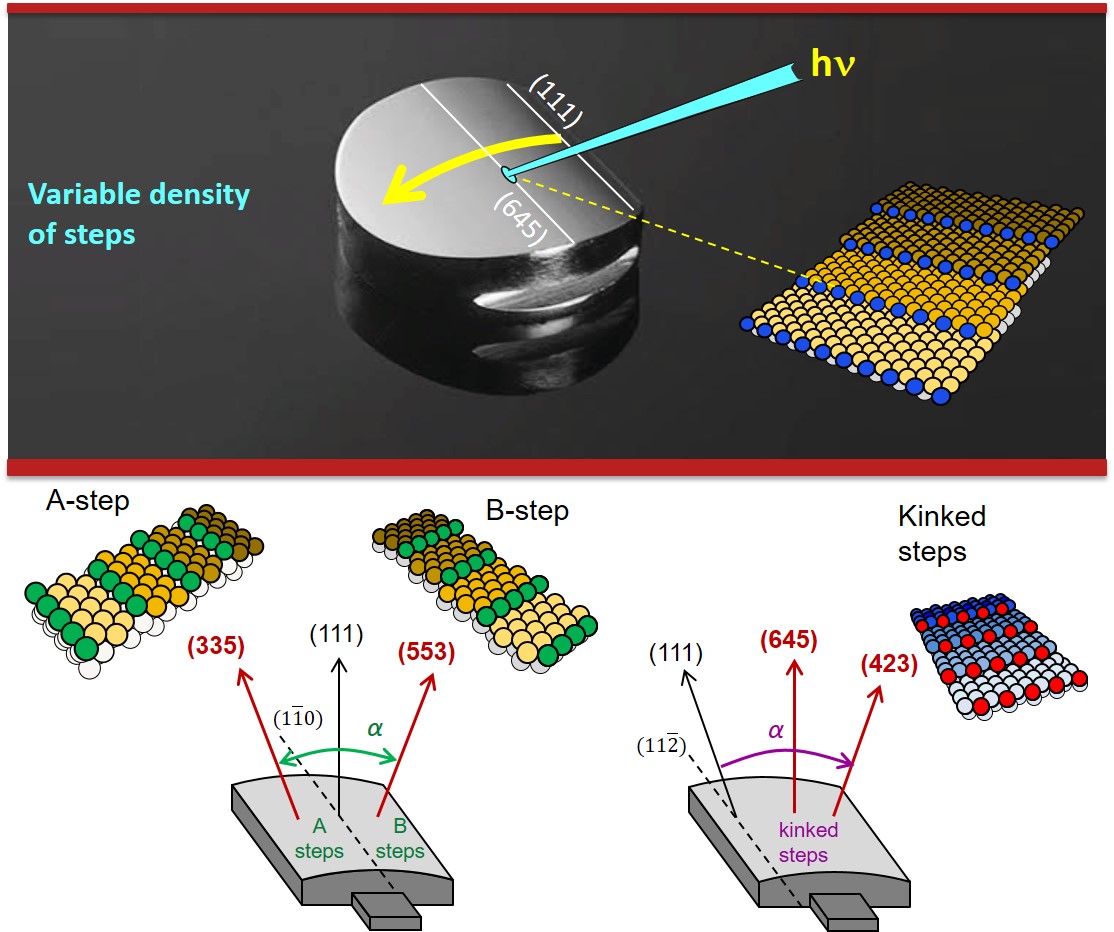
In 2006 the Nanophysics Lab group initiated a major research program to revisit and explore relevant surface properties and phenomena at vicinal surfaces, following a comprehensive and systematic approach, i.e., using cylindrical sections of crystals in order to span a wide range of vicinal planes. Our sample design, as shown in the figure, permits easy-processing in vacuum and macroscopic scanning of regular electron and photon probes, e.g., in standard LEED and photoemission setups. So far, more than 20 curved samples of different nature and orientation have been investigated, comprising the three coinage metals Cu, Ag, and Au, transition metals, such as Pt, Rh, and Pd, semiconductors, such as TiO2, or exotic elements, such as Bi and W.
Nowadays, and in conjunction with the rest of the Nanophysics Lab research lines and the Bihurcrystal start-up, we explore new concepts and surfaces, including kinked and chiral surfaces, more semiconductors and oxides, as well as bulk metal alloys. We aim at investigating the role of steps and kinks in chemical reactions and catalysis, using both ultra-high-vacuum and near-ambient pressure techniques, the step scattering properties of spin-textured electronic states, and the growth of nanostructures, such 1D polymers or 2D materials and bilayers, where curved surfaces act as tunable templates.
celia.rogero@csic.es
+34 943015804
Paseo Manuel de Lardizábal 5
20018, Donostia, Spain
