



Size-Dependent Dielectric Permittivity of Perovskite Nanocrystals
Perovskite nanocrystals are bright, solution-processable emitters with considerable potential for light-emitting, sensing and quantum-photonic technologies. Their performance can be greatly enhanced by placing them in optical cavities or next to nanoantennas. Designing such hybrid structures, however, requires an accurate description of the complex dielectric permittivity of an individual nanocrystal – and of how this response changes with particle size. Most available measurements instead provide values averaged over an ensemble of differently sized particles.
In this work, researchers at CFM, in collaboration with scientists from DIPC, CIC nanoGUNE BRTA, and Uppsala University, developed a route to reconstruct the size-dependent complex dielectric permittivity of individual perovskite nanocrystals from the absorbance spectrum of a colloidal solution. The method combines the nanocrystal size distribution measured by transmission electron microscopy with a model of size-dependent excitonic transitions and their room-temperature line shapes. Maxwell-Garnett effective-medium theory and transfer-matrix calculations then connect the optical response of the individual nanocrystals to the experimentally measured response of the entire solution.
The reconstructed response successfully reproduces the measured absorbance and remains applicable to an independently prepared nanocrystal batch with a different size distribution. Importantly, the calculated linewidth of the first excitonic feature, closely agrees with the mean linewidth measured from individual nanocrystals. This agreement shows that information relevant to a single nanocrystal can be recovered from an ensemble measurement when particle-size dispersion and intrinsic spectral broadening are treated explicitly.
To demonstrate the practical value of the result, the extracted permittivity was incorporated into finite-element simulations of a perovskite nanocrystal coupled to a plasmonic nanocube. The nanoantenna concentrates the optical field near its lower corners and, for the smallest simulated gap, increases the nanocrystal absorption by more than fifty times. At very small separations, calculations based only on the field at one point differ by about 10% from the full-volume absorption calculation, highlighting the need to account for the strongly non-uniform field across the nanocrystal.
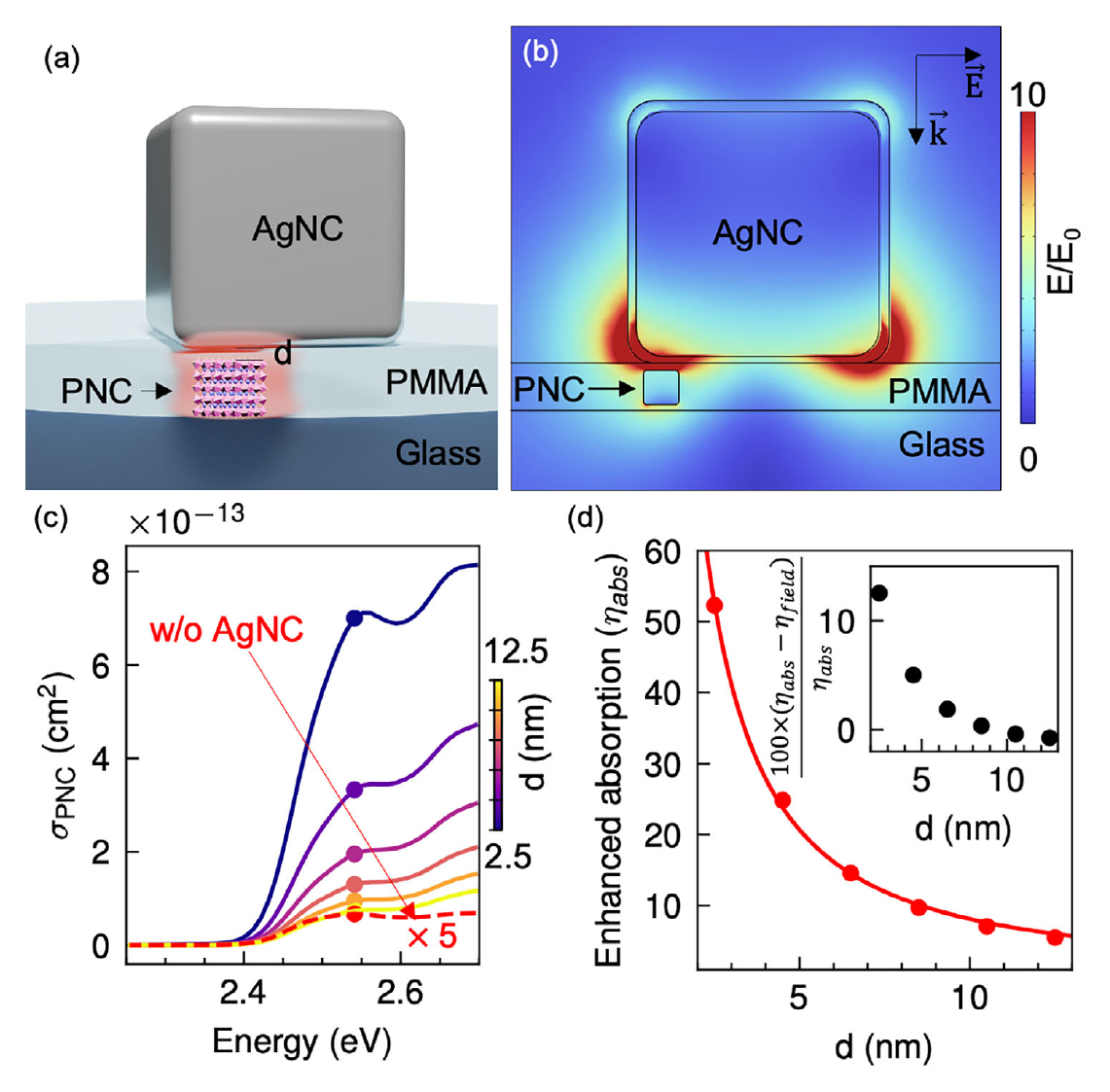
Figure showing a perovskite nanocrystal beneath a silver nanocube, the localized optical field around the nanocube corners, calculated absorption spectra for several gap sizes, and a graph demonstrating stronger absorption enhancement at smaller separations.
The study therefore bridges readily accessible ensemble spectroscopy and quantitative modelling at the single-particle level. The approach offers a practical foundation for designing perovskite nanocrystal cavities, nanoantennas and quantum-light devices, and can in principle be extended to other halide perovskites and conventional colloidal quantum dots.