



PhD Thesis Defense | Cristina Maciá
 Assessing the capabilities of compact neutron sources for construction materials
 Assessing the capabilities of compact neutron sources for construction materials
November 10, 10:00
CFM Auditorium
Candidate:Cristina Maciá
Supervisors: Félix Fernández Alonso y Jorge Sánchez Dolado
SUMMARY
Neutron-based techniques offer unique capabilities for the characterisation of construction materials, but their application is constrained by the limited accessibility of large-scale neutron facilities. This thesis evaluates the potential of Compact Accelerator-Driven Neutron Sources (CANS) as more accessible and cost-effective alternatives. Neutron Activation Analysis (NAA), Prompt Gamma Activation Analysis (PGAA), and energy-resolved Neutron Imaging (NI) were investigated using different neutron-source technologies, including D–D and D–T neutron generators at IAEA and NILE, and linac-based accelerator-driven sources at RIKEN (RANS). Their performance was benchmarked against established facilities: the Budapest Neutron Centre (BNC) reactor for elemental analysis and the PSI–ICON beamline for neutron imaging. Monte Carlo radiation transport simulations using PHITS complemented the experimental work, supporting the assessment of source capabilities and the optimisation of experimental configurations. Elemental analysis focused on major and minor constituents of cement, including chlorine and sulfur, which are relevant to reinforced concrete degradation. In addition, the potential for detecting light elements such as carbon and oxygen was investigated through experimental and simulation-guided optimisation of shielding strategies to reduce gamma-ray background. Overall, this work assesses the capabilities and limitations of compact neutron sources for the elemental and structural characterisation of cement-based materials, identifying opportunities for their further optimisation and application in materials research and infrastructure monitoring.
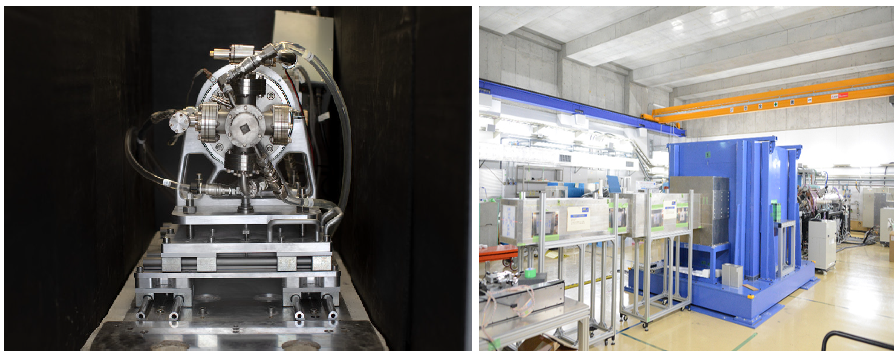
Left: D-T generator at NILE facility (ISIS, UK). Right: Overview of RA