


PhD Thesis Defense | Mohamad Barzegar
 Cement-Based Thermoelectric and Photothermoelectric Materials for Low-Grade Heat and Solar Energy Harvesting
 Cement-Based Thermoelectric and Photothermoelectric Materials for Low-Grade Heat and Solar Energy Harvesting
November 9, 11:00
CFM Auditorium
Candidate: Mohamad Barzegar
Supervisor: Jorge Sánchez Dolado
SUMMARY
Urban infrastructure absorbs and dissipates substantial low-grade heat, particularly under solar irradiation, yet this energy remains largely unused. Cementitious materials offer a scalable, low-cost, and structurally compatible platform for distributed energy harvesting, but their thermoelectric application is limited by low output, environmental sensitivity, and incomplete understanding of charge-transport mechanisms. This thesis investigates cement-based thermoelectric (TE) and photothermoelectric (PTE) systems from material-level transport to device-level solar energy harvesting and environmental performance.
The work first clarifies the role of ionic thermoelectricity in alkali-activated cementitious materials. Geopolymer-based hybrid cement, copper-slag-modified composites, kaolin-clay geopolymers, and GGBFS-based systems were studied to determine how binder chemistry, pore structure, moisture state, intrinsic voltage, and ionic mobility govern the Seebeck response. A significant intrinsic voltage was identified as a critical source of measurement bias, leading to a refined protocol that separates true thermally induced voltage from pre-existing electrochemical potential. The kaolin- and slag-based systems further showed that TE polarity and magnitude are controlled by the balance between dominant ionic species, pore connectivity, activator content, and thermal conductivity rather than by ionic concentration alone.
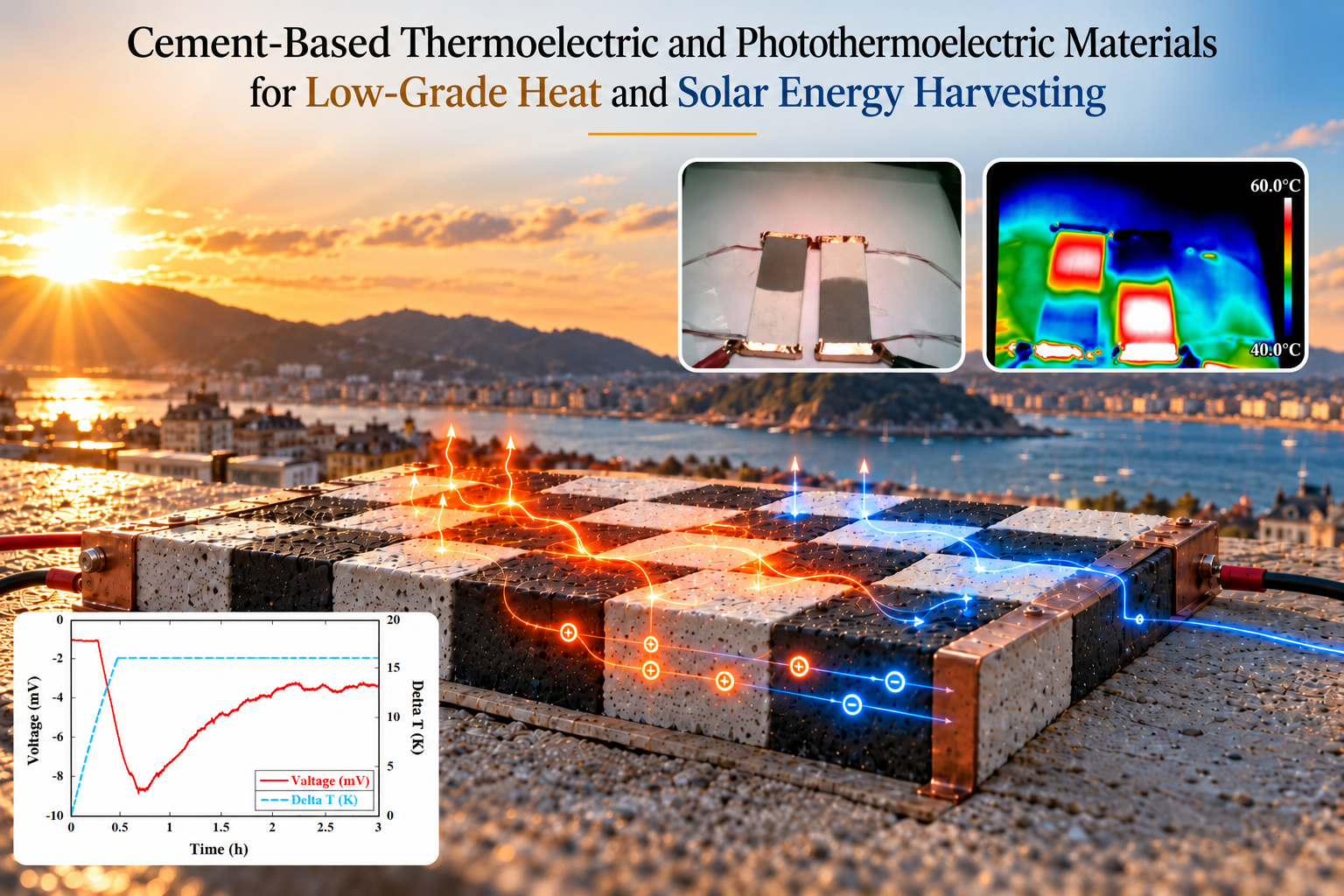
Building on this mechanistic understanding, a chessboard-like PTE cement cell was developed by combining a high-absorbance geopolymer/copper-slag segment with a high-reflectance white-cement segment. This architecture generates a lateral temperature gradient under illumination, coupling photothermal heating with ionic TE voltage generation. Outdoor testing of two series-connected cells produced a Seebeck coefficient of 9.9 mV K⁻¹, confirming effective solar-driven operation under real conditions. Further optimization increased the harvested energy to 1.81 × 10⁶ µJ m⁻² over one hour, demonstrating competitive performance while retaining the advantages of low cost, processability, and large-area scalability.
The environmental response of the PTE system was then evaluated under static and dynamic climatic conditions. Controlled chamber tests showed that relative humidity and temperature directly regulate output by controlling ionic pathway stability and thermodiffusive mobility. Dynamic simulations revealed that voltage generation depends on the coupled evolution of irradiation, moisture availability, and thermal gradients, rather than solar intensity alone. The ability of humid conditions to restore performance after drying highlights the moisture-rechargeable nature of cementitious ionic TEs.
Overall, this thesis establishes cement-based thermoelectricity as an environmentally responsive energy-harvesting mechanism and advances it toward scalable PTE materials. Its main contributions are the clarification of ionic transport as the governing mechanism, the identification and correction of intrinsic-voltage effects, the use of industrial geopolymers and aggregates for functional cement design, and the demonstration of a solar-driven cement cell operating under realistic environmental conditions. These findings provide a foundation for multifunctional cementitious materials capable of harvesting low-grade heat and solar energy directly from the built environment.