



High-Pressure Synthesis of a Polymeric N3H2 Solid Stabilized by Hydrogen Bonds
Nitrogen can store more chemical energy than any other element. In polymeric nitrogen, where the atoms are linked by single bonds, decomposition into N2 gas releases a huge amount of energy. This makes it a long-sought high-energy-density material. However, pure polymeric nitrogen forms only at extreme pressures and does not survive return to ambient conditions. Hydrogen has been proposed to stabilize such frameworks, but polymeric nitrogen–hydrogen solids had so far existed only in theoretical predictions.
In a new work led by Dr. Umbertoluca Ranieri (CFM), in collaboration with the University of Edinburgh, CEA and the ESRF, laser-heating N2–H2 mixtures in diamond anvil cells at 134–139 GPa produced a previously unknown polymeric compound, N3H2. Synchrotron single-crystal X-ray diffraction, Raman spectroscopy and first-principles calculations reveal a single-bonded framework of infinite chains of puckered N6 rings, each carrying four hydrogen atoms. The chains are cross-linked to one another through hydrogen bonds.
Hydrogen scatters X-rays very weakly, and it had never been located in high-pressure compounds above 25 GPa. Thanks to the brightness of the ESRF Extremely Brilliant Source, the hydrogen positions in N3H2 were resolved directly from the diffraction data at 139 GPa, and found to be in close agreement with the results of density functional theory. Single-crystal X-ray diffraction measurements were also performed at DESY.
N3H2 survives decompression down to at least 26 GPa, well below the pressure at which pure polymeric nitrogen is lost. At ambient pressure, it is predicted to release about 8 kJ/g when it decomposes into N2 and NH3, almost twice as much as conventional explosives like TNT. As the first experimental realization of a polymeric nitrogen–hydrogen compound, this result points to hydrogen-stabilized polymeric nitrogen as a promising new class of energetic materials.
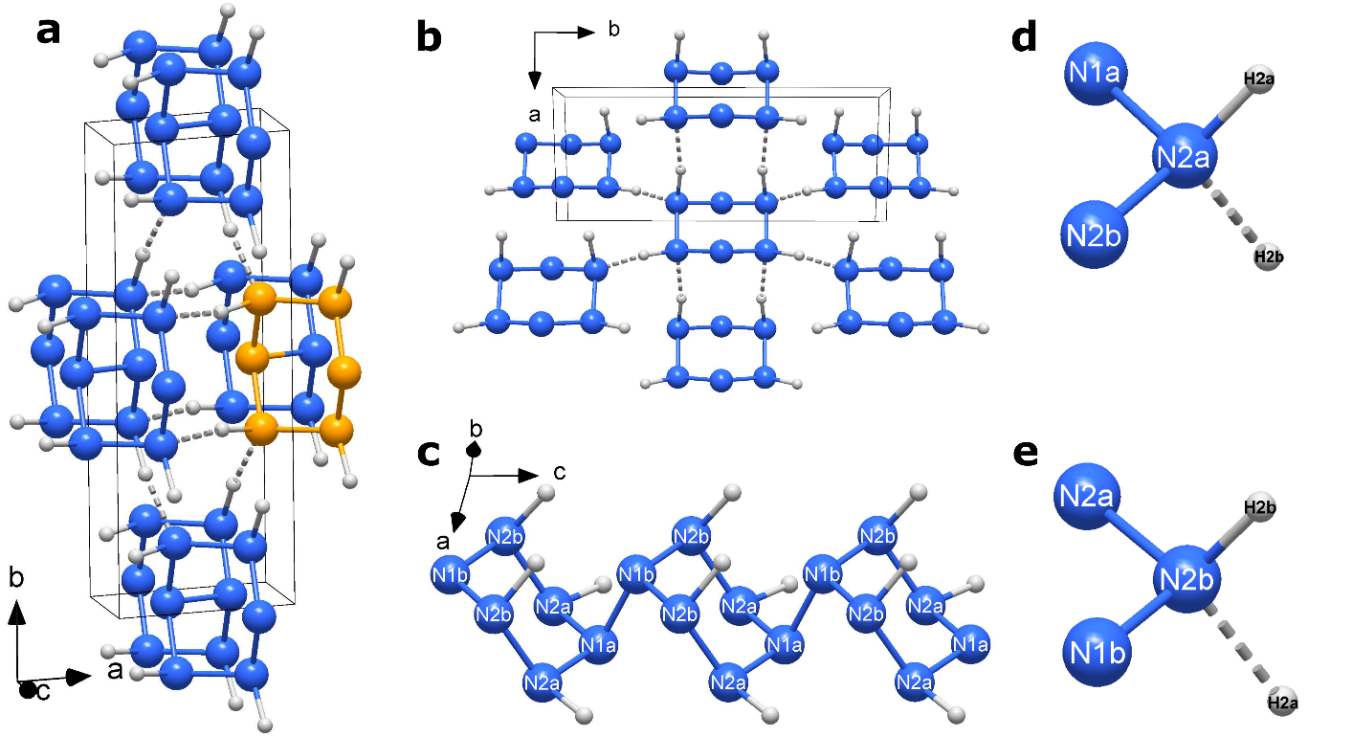
Figure: Crystal structure of N3H2 at 139 GPa. Blue and white spheres are nitrogen and hydrogen atoms, and dashed white lines are hydrogen bonds. (a) Unit cell, with one N6 ring highlighted in orange. (b) View along the c-axis, showing all eight hydrogen bonds made by one N6H4 unit with its neighboring chains. (c) Fragment of an infinite chain of linked N6H4 units running along the c-axis. (d, e) Trigonal-pyramidal environment of the two distinct nitrogen atoms bonded to hydrogen. Figure from DOI: 10.1038/s41467-026-79382-z.