



Unidirectional rotation in a molecular motor driven by angular-momentum transfer via helical orbitals
As electronic components keep shrinking, conventional conductors eventually reach their physical limits: a metallic track only a few atoms wide is no longer stable at room temperature. Individual molecules, held together by much stronger chemical bonds, are a promising alternative, and researchers are exploring how single molecules can perform specific electrical and mechanical functions. One long-standing challenge is to make a molecular motor turn consistently in one direction. In biological motors and in light-driven Feringa-type motors, this requires exciting the molecule into a high-energy state and relying on a built-in steric “ratchet” that lets it relax in only one direction.
In this work, CFM researcher María Camarasa-Gómez, in collaboration with scientists from Karlsruhe Institute of Technology (KIT) and other European institutions, demonstrates a fundamentally different drive mechanism. The team designed and synthesised a molecule made of three parts: a tripod-shaped platform anchored to a gold surface, an upright axle formed by a carbon–carbon triple bond, and a compact chiral rotor (a “Geländer”-type group) mounted on top. Density functional theory and quantum transport calculations revealed that the electronic orbitals of the axle are helical. When an electric current flows through them, the electrons wind around the axle and carry orbital angular momentum, which is transferred to the rotor and sets it spinning – much like a garden hose that moves when water flows through it.
The prediction was tested with a scanning tunnelling microscope operating at 5 K. With the tip held fixed above a single molecule, the tunnelling current switched between three levels corresponding to three rotational positions of the rotor. The sequence of these switches showed a clear preferred direction of rotation, ruling out random motion with high statistical significance. Strikingly, the molecule kept turning the same way when the current direction was reversed – exactly as predicted, because the occupied and unoccupied helical orbitals that carry the current at opposite voltages have opposite helicity. Rotation also appeared only at voltages matching the energies of these orbitals, and lost its directionality at higher voltages, excluding ratchet-type and electric-field-driven explanations.
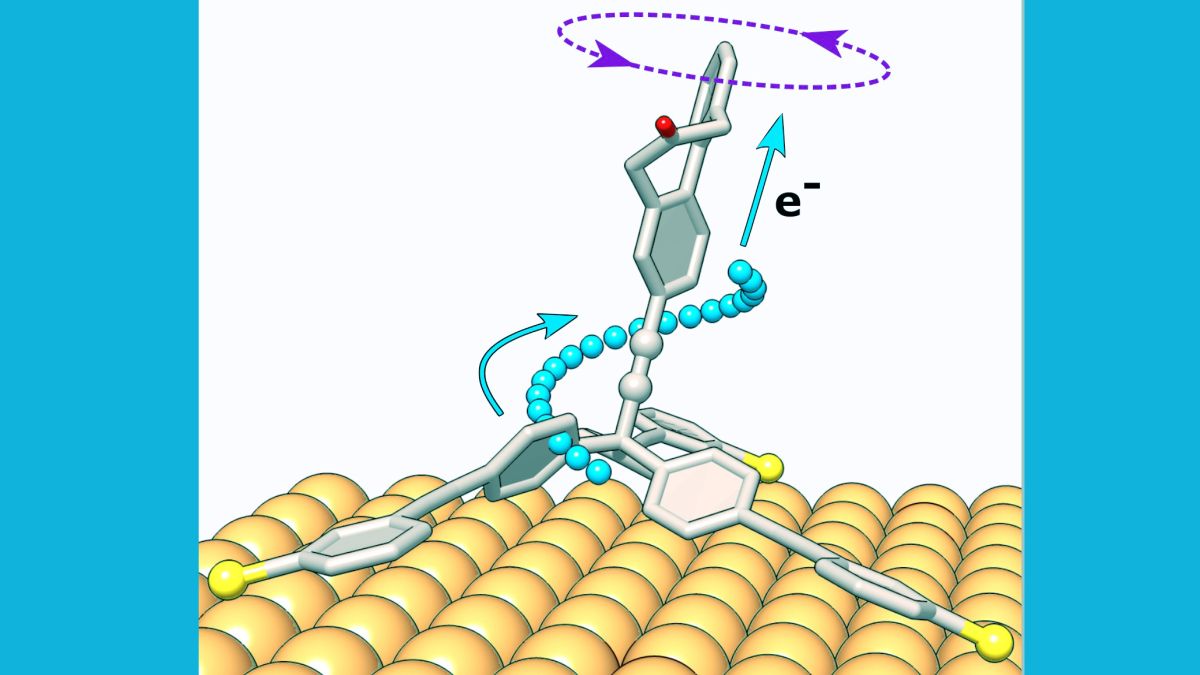
A helical molecule anchored to a gold surface: electrons (e⁻) flowing through the helical orbitals of the triple-bond axle transfer angular momentum to the rotor, which turns in a fixed direction. Image: Lukas Gerhard, KIT.
The results establish a new principle for driving molecular motors that needs neither excited states nor ratchet potentials, potentially enabling more energy-efficient operation. Although much more research is needed before any application, the mechanism could inspire functional surface coatings and contribute to understanding orbital currents and chirality-induced effects at the single-molecule level.