



The Gipuzkoa Coopera initiative builds a scientific bridge between Latin American women researchers and the Materials Physics Center
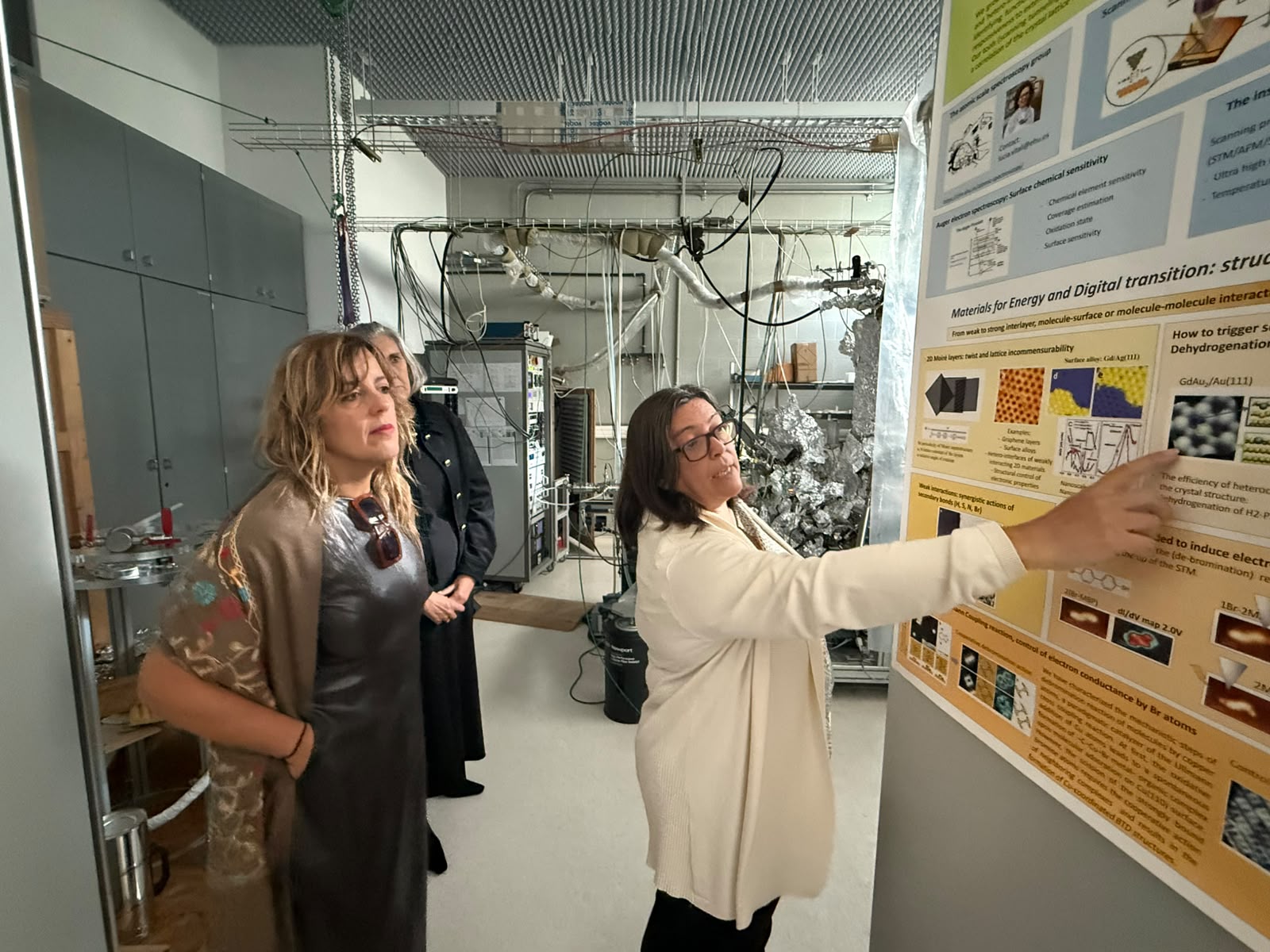
Left to right, the Deputy Goizane Álvarez with Celia Rogero, CFM´s director.
The Provincial Deputy for Culture, Cooperation, Youth, and Sports, Goizane Álvarez visited the center and met with the research staff participating in two Gipuzkoa Coopera projects that promote the leadership of women scientists and stable collaboration with teams from Argentina and Brazil.
The Provincial Deputy for Culture, Cooperation, Youth, and Sports, Goizane Álvarez, visited the Materials Physics Center (CFM) to learn firsthand about the scientific cooperation projects that the center is developing with the support of the Department of Culture and Cooperation of the Provincial Council of Gipuzkoa. During the visit, Álvarez was able to see the work being carried out in the laboratories and hold a meeting with the researchers and staff directly participating in these initiatives.
The CFM is currently developing, within the framework of Gipuzkoa Coopera, two collaboration projects with scientific teams from Argentina and Brazil, both planned for a two-year duration. Their common goal is to foster stable scientific relations with Latin American teams, strengthen the skills and leadership of women researchers, facilitate their international projection, and promote exchanges and research stays in Gipuzkoa.
Álvarez highlighted that these projects show “a particularly interesting way of understanding cooperation: putting the capabilities we have in Gipuzkoa at the service of peer-to-peer relationships, sharing knowledge, and generating opportunities that remain far beyond specific aid.”
The deputy placed special emphasis on the gender perspective of the initiative. The program seeks to promote the leadership of women scientists, strengthen their skills, and enhance their visibility within the international scientific community, in addition to consolidating cooperation between the participating centers.
“There are still highly significant inequalities regarding women’s access to positions of greater scientific responsibility. Therefore, it is important that public institutions contribute to opening opportunities, generating networks, and ensuring that a researcher’s talent does not face further limits due to her gender or the place in the world where she develops her career,” Álvarez pointed out.
Two projects with Argentina and Brazil
One of the projects is led at the CFM by researcher Silvina Cerveny, in collaboration with María Guadalupe García’s team from the Institute of Applied Physics of San Luis, linked to CONICET and the National University of San Luis in Argentina. The project investigates zinc-crosslinked pectin materials to advance towards more sustainable water and nutrient management in agriculture.
The research aims to develop biodegradable materials that can become an alternative to the polyethylene plastics used to cover agricultural soils. In addition to avoiding the generation of plastic waste, the new materials aim to incorporate other functionalities, such as storing and releasing nutrients or contributing to the improvement of irrigation water quality.
Initial work has already yielded pectin and zinc formulations with a better balance of strength, flexibility, and water stability. Predoctoral researcher Julieta Quiroga, from the Argentine team led by María Guadalupe García, is carrying out a six-month stay at the Gipuzkoan center, between May and late October of this year, working on this project.
The second project connects Ivan Sasselli’s team at the CFM with the group led by Carolina Horta Andrade from the Federal University of Goiás in Brazil. The research analyzes the bioactivity of functionalized nanofibers and combines molecular simulations, chemoinformatics, machine learning, and artificial intelligence with the goal of developing models to predict their behavior. Among its possible applications is the development of new therapeutic strategies against diseases such as Zika or Dengue. For its development, predoctoral researcher Fernanda Campos is, in turn, completing a stay at the CFM.
“Thanks to Gipuzkoa Coopera, we’re designing models that I wouldn’t have been able to develop on my own. By pooling our knowledge, we’re making progress in understanding how to develop materials—in our case, more effective medications.” Ivan Sasselli
Thus, both projects include stays for Latin American research staff in Donostia, working in the CFM laboratories and gaining access to computing resources, meetings between the different groups, and scientific exchange activities. The purpose is for the generated relationships to continue once Gipuzkoa Coopera concludes, giving rise to new research, publications, and joint projects.
Cooperation that generates lasting ties
The collaboration of the Materials Physics Center with cooperation programs backed by the Provincial Council has prior history. Since 2019, the center has developed various collaborations with the Women for Africa Foundation, and in 2026, it reformulated the program through an internal call specifically aimed at generating longer-term scientific projects with teams from Latin America.
The CFM is a joint center of the Spanish National Research Council (CSIC) and the University of the Basque Country (UPV/EHU), distinguished as a BERC center of excellence, whose objective is to advance the fundamental understanding of matter through the discovery of emergent phenomena derived from the interplay between structure, dynamics, and interactions at different spatial and temporal scales. This mission provides the conceptual basis for addressing the major scientific and technological challenges of the future.