


CFM researcher Gustavo Ariel Schwartz participates in the CSIC’s 1st Art and Science Biennial: ‘Experiences in dialogue’
Dance, theater, music, literature, and the visual and audiovisual arts take the stage today at the CSIC to bring creation and research into dialogue.
The headquarters of the Spanish National Research Council (CSIC) in Madrid is hosting the 1st Art and Science Biennial (BAC), organized by the public body. The event brings together CSIC staff working at the intersection of art and science, artists from different disciplines, and representatives from cultural institutions with the aim of exchanging experiences and strengthening ties.
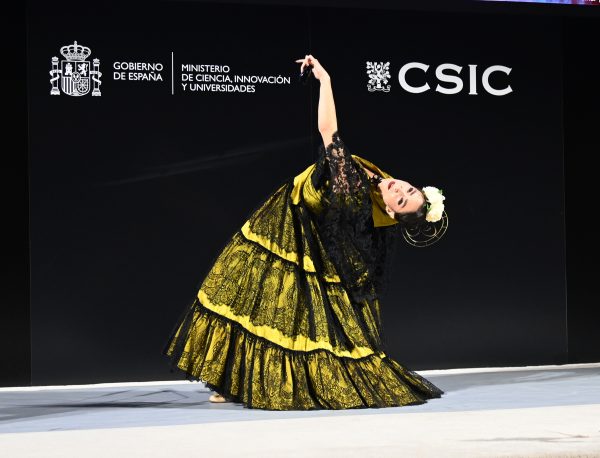
Under the slogan ‘Experiences in dialogue’, the program of this first biennial includes showcases of several art and science projects covering dance, theater, music, poetry, and the visual and audiovisual arts. María Cabrera (Institute of History, IH-CCHS-CSIC) was the first to take the stage to perform the dance piece Goyesca, by Teresina Boronat. Following her, attendees enjoyed the poetry of Carlos Briones, a CSIC researcher at the Center of Astrobiology (CAB-CSIC-INTA), accompanied by the flute of Miriam Ridruejo.
The documentary El origen de la vida (The Origin of Life), produced by La Bestia Produce for LifeHUB CSIC, and the play El tercer elemento (The Third Element), by Víctor Iriarte and performed by the TeatrIEM group, continued the day’s program. It also included the screening of the short film Cajal libremente (Cajal Freely), produced by the CSIC and directed by José Luis Trejo (Cajal Neuroscience Center, CNC-CSIC) and Sergio Lara, as well as a dramatized reading of the play La entrevista (The Interview), by Gustavo A. Schwartz of the CFM (CSIC-EHU) and Luisa Etxenike.
The CFM researcher is also participating in the roundtable “Situated Experiences” and is a member of the Art and Science Group of the Deputy Vice-Presidency for Scientific Culture and Citizen Science (VACC).
In total, the biennial features three roundtables in which CSIC staff shared learnings and career paths with creators—such as artist José Ramón Ais, stage creator Laura Santos, and creative director Roberto Torres—as well as with representatives from the International University of Andalusia, the Condeduque Contemporary Culture Center, Thyssen-Bornemisza Art Contemporary, and the Círculo de Bellas Artes.
Finally, as part of the CSIC’s 1st BAC, the following exhibitions can be visited from October 1 to 7: Planktographica (CSIC headquarters lobby; Serrano, 117), FOTCIENCIA21 (CSIC Scientific Bookstore; Serrano, 123), El esqueleto del cambio climático (The Skeleton of Climate Change), and Arte Plumario: Naturaleza, Identidad y Poder (Feather Art: Nature, Identity, and Power) (National Museum of Natural Sciences; José Gutiérrez Abascal, 2).
120 years of the JAE
Organized by the Art and Science Working Group of the CSIC’s Deputy Vice-Presidency for Scientific Culture and Citizen Science, this meeting is part of the celebration of the 120th anniversary of the Board for Advanced Studies and Scientific Research (JAE), the public institution that gave rise to the Spanish scientific system and was the predecessor of the CSIC.
“This day seeks to activate and inspire CSIC staff interested in the intersection between art and science by showing close, diverse, and possible examples, as well as to strengthen ties between the CSIC community and external strategic collaborators (artists, cultural institutions, funding foundations) who already work with our institution or may do so in the future,” notes Pura Fernández, Deputy Vice-President for Scientific Culture and Citizen Science at the CSIC. “Inspired by that intellectual and scientific adventure that was the JAE, we want to bring artistic creation and scientific knowledge back into dialogue, continue building bridges between art and research, and imagine new ways of thinking, creating, and transforming the world,” she adds.